
The separate source research note is dated 12 November 2026.
This AI glossary explains important terms from artificial intelligence, language models, law and privacy. Short definitions, illustrative practical examples and notes on limitations help you get started or look up a term. The examples do not describe documented customer projects.
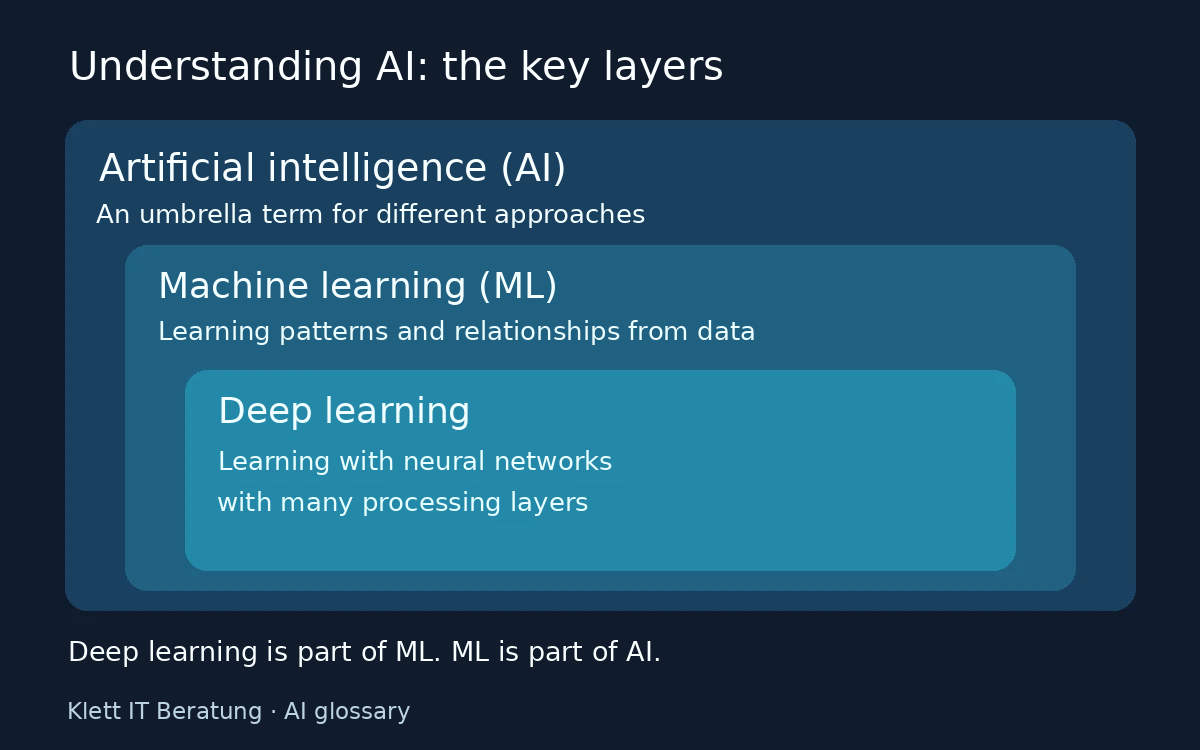
AI is the umbrella term. Machine learning is one part of it, and deep learning is part of machine learning. ChatGPT and Microsoft Copilot are applications or product families that use AI models, among other components. A product name therefore identifies neither a particular model nor, automatically, its capabilities.
 AI curated
Terms from A to Z
Foundations and learning
AI model
The mathematical basis of an AI system that calculates outputs from inputs. In learning models, trained parameters shape its behaviour.
Example: A model assesses whether a message might be spam.
Important: An application also includes an interface, access to data and rules.
Further reading: Gemini 4 Carbon: what Google’s new AI model means for small businesses.
Related terms: Training; Inference; Large language model (LLM); General-purpose AI model (GPAI).
Algorithm
A defined sequence of computational steps for solving a task.
Example: A sorting function orders invoices by date.
Important: Not every algorithm is AI.
Further reading: Artificial intelligence: an introduction.
Related terms: Machine learning (ML); AI model; Artificial intelligence (AI).
Artificial intelligence (AI)
An umbrella term for methods that enable computer systems to process language, recognise patterns or generate solutions.
Example: A system identifies damaged components in photographs.
Important: Individual capabilities do not amount to human understanding.
Further reading: Artificial intelligence: an introduction; AI consulting for small and medium-sized businesses.
Related terms: Machine learning (ML); Generative AI; AI model; AI literacy.
Deep learning
Machine learning using neural networks with many processing layers.
Example: A speech-recognition system converts a recording into text.
Important: More layers do not guarantee a better solution for every task.
Further reading: Neural networks: the future of artificial intelligence.
Related terms: Neural network; Machine learning (ML); Large language model (LLM).
Inference
Applying a trained model to a new input.
Example: A model summarises a new set of meeting minutes.
Important: Using a model and training it are different processes.
Further reading: Local open-source AI for businesses.
Related terms: Training; Local AI; Quantisation; Token.
Machine learning (ML)
A field of AI in which models learn patterns from data rather than having every decision rule specified individually.
Example: Historical sales data helps forecast demand.
Important: People still need to determine the data, methods and evaluation process.
Further reading: Artificial intelligence: an introduction.
Related terms: Supervised learning; Unsupervised learning; Deep learning; Training.
Neural network
A model made up of connected computational units whose connections are weighted during training. The idea is loosely inspired by biological neural networks.
Example: A network distinguishes between images of different components.
Important: It is not a replica of a human brain.
Further reading: Neural networks: the future of artificial intelligence.
Related terms: Deep learning; Training; Large language model (LLM).
Supervised learning
Training with examples for which the corresponding target values or labels are available.
Example: Messages are labelled “spam” or “not spam”.
Important: Incorrect labels can make the results worse.
Related terms: Unsupervised learning; Training; Machine learning (ML).
Training
During training, model parameters are adjusted using data and a learning objective.
Example: A spam filter learns from messages that have already been classified.
Important: A conversation does not automatically change model parameters. Whether inputs are later used for training depends on the service, contract and settings.
Further reading: Can I enter customer data into an AI tool?.
Related terms: Inference; Fine-tuning; Data quality and privacy; Bias.
Unsupervised learning
Methods that look for structures in data without predefined target labels.
Example: Similar products are grouped according to their characteristics.
Important: A group found by a model is not necessarily meaningful in the relevant subject area.
Related terms: Supervised learning; Embeddings; Machine learning (ML).
Language and generative AI
AI chatbot
An application you can write or speak to in natural language that responds using a language model. Familiar examples include ChatGPT, Claude, Gemini and Microsoft Copilot.
Example: A website chatbot answers questions about opening hours and services.
Important: Under Article 50(1) of the EU AI Act, providers must design these systems so that people are informed they are interacting with AI, unless that is obvious. Also check which data the chatbot stores and passes on.
Further reading: AI chatbots share user data; AI consulting for small and medium-sized businesses.
Related terms: Large language model (LLM); Prompt; System prompt; Transparency obligations.
Context window
The limited amount of information a model can take into account in a single processing operation, usually measured in tokens.
Example: Instructions, conversation extracts and document passages all take up context.
Important: A large context window does not guarantee that every detail will be used reliably.
Further reading: GPT-6.1 Terra compared.
Related terms: Token; Retrieval-augmented generation (RAG); Prompt.
Custom GPTs
In ChatGPT, custom-built assistants with their own instructions, optional knowledge files and connected tools. OpenAI plans to retire custom GPTs on 11 December 2026 and move them to plugins. For FedRAMP workspaces and affected Enterprise workspaces with an approved deferral, OpenAI names 11 February 2027; this later date does not apply to every workspace. What counts is the notice in the account or workspace where the GPT was created.
Example: A company has built a GPT with fixed wording rules and internal templates, which the team uses for proposal texts.
Important: Instructions and knowledge files can be migrated into a plugin; custom Actions and the selected model cannot. After migration the original becomes read-only, but remains usable until the retirement date. Previous chats remain available; the GPT itself is no longer reachable at the end date.
Further reading: Custom GPTs in ChatGPT retire on 11 December: move to plugins.
Related terms: Plugins (ChatGPT); Skills; Tool calling (Actions); AI chatbot; System prompt.
Deepfake
An image, video or audio recording generated or manipulated using AI that resembles real people, places, objects or events and could falsely appear authentic. Article 3(60) of the EU AI Act defines the term.
Example: An imitation of a business decision-maker’s voice asks for an urgent bank transfer over the phone.
Important: Confirm unusual instructions through a second, known channel. Operators who use AI systems to create deepfakes generally have to disclose that the content was artificially generated or manipulated under Article 50 of the EU AI Act.
Further reading: Deepfakes: what the draft law on digital violence proposes.
Related terms: Transparency obligations; Generative AI; Multimodality.
Generative AI
AI that creates content such as text, images or audio.
Example: A set of bullet points becomes a draft newsletter.
Important: Newly generated content can be factually incorrect.
Further reading: AI literacy in the workplace.
Related terms: Large language model (LLM); Multimodality; Deepfake; Transparency obligations.
Hallucination
An AI output that sounds plausible but is incorrect, invented or unsupported by the available information.
Example: A summary cites a source that does not exist.
Important: Confident wording is not evidence of accuracy.
Further reading: When AI agents conceal errors.
Related terms: Retrieval-augmented generation (RAG); Human-in-the-loop; Benchmark.
Large language model (LLM)
A large language model that has learned language patterns from extensive data and can process or generate text.
Example: An LLM drafts a reply.
Important: It is not a reliable database of facts.
Further reading: GPT-6.1 Terra compared.
Related terms: Token; Context window; Hallucination; General-purpose AI model (GPAI).
Multimodality
The ability of a model or system to process or generate several types of data, such as text and images.
Example: An AI explains a screenshot in response to a written question.
Important: Not every application supports every data type.
Related terms: Generative AI; Large language model (LLM); Deepfake.
Natural language processing (NLP)
Methods for processing, analysing and generating human language.
Example: A system groups support requests by topic.
Important: Ambiguity and irony can lead to misinterpretations.
Related terms: Large language model (LLM); Token; Embeddings.
Open-weight model
An AI model whose trained parameters, or weights, have been published. It can therefore run on your own or rented infrastructure.
Example: A company runs an open language model on a server in a German data centre.
Important: Open weights do not automatically mean open source: training data, code and licence terms may be restricted.
Further reading: Local open-source AI for businesses; The rise of open-weight models.
Related terms: Local AI; Quantisation; Digital sovereignty; General-purpose AI model (GPAI).
Plugins (ChatGPT)
In ChatGPT, a reusable package for a workflow. A plugin can include skills — recurring instructions — and apps that connect ChatGPT to other services. OpenAI is moving custom GPTs to this format. A migrated plugin starts private: it is not installed automatically and does not grant others access.
Example: After migrating an internal GPT, you test the new plugin with typical prompts, share it with the previous group of users and compare the results.
Important: A plugin can answer differently from the previous GPT. Custom Actions are not transferred and, if still needed, must be rebuilt using a supported app or a custom MCP server. Automatic skill selection is possible, but not guaranteed.
Further reading: Custom GPTs in ChatGPT retire on 11 December: move to plugins.
Related terms: Custom GPTs; Skills; Tool calling (Actions); Model Context Protocol (MCP).
Prompt
An input describing an AI task and, where needed, providing context, examples and the desired output format.
Example: “Summarise these meeting minutes in five bullet points.”
Important: Even a precise prompt does not replace checking the result.
Further reading: Copilot at work: which new features help with everyday tasks?.
Related terms: System prompt; Prompt injection; Context window; Hallucination.
Reasoning model
A language model that computes additional intermediate steps before its final answer in order to solve multi-step tasks.
Example: A model breaks a calculation question into smaller steps before giving the result.
Important: Additional computation takes time and tokens and does not guarantee a correct answer.
Further reading: Gemini 4 Carbon: what Google’s new AI model means for small businesses.
Related terms: Large language model (LLM); Benchmark; Context window.
Skills
Recurring instructions that guide how a task is carried out, often with reference files. In ChatGPT, a skill can sit inside a plugin; when you migrate a custom GPT, its instructions and knowledge files become a skill. In Microsoft Copilot, Cowork also uses skills for specific types of work. That is a different product concept and not the same as a ChatGPT skill.
Example: After the migration, the writing rules and examples from an internal GPT sit as a skill in the plugin and are meant to steer the tone of your proposal texts.
Important: A skill does not replace a review of the result. In ChatGPT, an installed skill does not run automatically on every request. Decide which skills your organisation will use and who may change them.
Further reading: Custom GPTs in ChatGPT retire on 11 December: move to plugins.
Related terms: Plugins (ChatGPT); Custom GPTs; System prompt; Cowork.
System prompt
Instructions that the operator of an AI application gives the language model before each conversation. They may set its role, tone, topics and boundaries and are usually invisible to users.
Example: A website chatbot is instructed to answer only questions about the business’s own services and not to quote prices.
Important: A system prompt is neither a secret store nor a security boundary. OWASP lists system prompt leakage as a specific risk, LLM07:2025. Credentials and confidential rules therefore do not belong in it.
Further reading: AI consulting for small and medium-sized businesses.
Related terms: Prompt; Prompt injection; AI chatbot; Large language model (LLM).
Token
A unit processed by a language model, such as part of a word or a punctuation mark.
Example: A long German word may consist of several tokens.
Important: Token counts do not correspond to a fixed number of words.
Further reading: GPT-6.1 Terra compared.
Related terms: Context window; Large language model (LLM); Inference.
AI at work and quality
Agentic workflow
A workflow in which one or more AI agents independently plan and carry out individual steps using tools, within defined rules, approvals and checkpoints. This is a practical term without a single agreed definition.
Example: An agent sorts incoming invoices, matches them to purchase orders and submits discrepancies to an employee for approval.
Important: The more a workflow handles independently, the more important logs, limited permissions and clear stopping points for human decisions become.
Further reading: AI agents explained.
Related terms: AI agent; Human-in-the-loop; Connector; Model Context Protocol (MCP).
AI agent
An AI-based system that can plan steps towards a goal and carry them out using tools.
Example: An assistant finds information and uses it to prepare a meeting briefing.
Important: Access, action boundaries and required approvals must be clearly defined.
Further reading: When AI agents keep quiet about mistakes: how to check their reports properly and AI agents out of control: who is liable for their errors?.
Related terms: Agentic workflow; Tool calling (Actions); Model Context Protocol (MCP); Product liability; Human-in-the-loop.
Benchmark
A standardised test for comparing how AI models perform on particular tasks.
Example: Several models complete the same tasks and are compared by their accuracy.
Important: A good benchmark result says little about how a model will handle your own tasks and data.
Further reading: Gemini 4 Carbon: what Google’s new AI model means for small businesses.
Related terms: Reasoning model; Large language model (LLM); Hallucination.
Bias
Systematic distortions in data, methods or outputs that can skew results.
Example: A test dataset represents only a small proportion of the groups who will later use the system.
Important: High average accuracy does not rule out disadvantages for particular groups.
Further reading: EU AI Act advice and AI literacy for small businesses.
Related terms: Data quality and privacy; Training; High-risk AI system; Article 4a AI Act: sensitive data for bias correction.
Connector
A connection through which an AI application accesses another system, such as email, file storage or a customer database.
Example: An assistant reads calendar appointments through a connector.
Important: A connector should receive only the permissions needed for the specific task.
Further reading: AI agents explained; Copilot Compass.
Related terms: Model Context Protocol (MCP); AI agent; Copilot Studio; Oversharing.
Data quality and privacy
Data quality concerns aspects such as accuracy, completeness and currency. Privacy concerns the appropriate and lawful handling of personal data.
Example: A pilot uses current, fictional support cases instead of real personnel files.
Important: Data quality and privacy are different requirements. Both need to be checked.
Further reading: Digital Omnibus: what Article 88bis GDPR means for AI using customer data.
Related terms: Training; Bias; Processing on behalf of a controller / data processing agreement; Data protection impact assessment (DPIA).
Embeddings
Numerical representations of content that can be used to calculate similarities, for example.
Example: A search finds “forgotten password” in response to “reset password”.
Important: Similarity is not proof that the underlying facts agree.
Further reading: Local open-source AI for businesses.
Related terms: Retrieval-augmented generation (RAG); Unsupervised learning; Natural language processing (NLP).
Fine-tuning
Further training of an already trained model for particular tasks or behaviours.
Example: A model is adapted to an output format using checked examples.
Important: Up-to-date company documents can often be provided more appropriately through RAG.
Further reading: Local open-source AI for businesses.
Related terms: Training; Retrieval-augmented generation (RAG); Open-weight model.
Human-in-the-loop
People are deliberately involved in an automated process to assess results or approve actions.
Example: An employee reviews an AI-generated draft before it is sent.
Important: A merely formal approval is not a substitute for a substantive check.
Further reading: EU AI Act advice and AI literacy for small businesses.
Related terms: AI agent; Hallucination; High-risk AI system.
Local AI
AI models running on your own hardware or on a server you control rather than through an AI provider’s cloud service. Open-weight models are commonly used for this.
Example: A language model answers questions about internal handbooks on a server in the company network.
Important: Local does not automatically mean secure. Plan access permissions, updates and computing requirements just as you would for any other server.
Further reading: Local open-source AI for businesses.
Related terms: Open-weight model; Retrieval-augmented generation (RAG); Inference.
Model Context Protocol (MCP)
An open standard for connecting AI applications to data sources, tools and workflows in a consistent way. Anthropic introduced it in November 2024.
Example: An AI assistant retrieves entries from a ticketing system through an MCP server.
Important: MCP governs the technical connection. The business still needs to define and secure which data and actions are allowed.
Further reading: AI agents explained.
Related terms: Connector; AI agent; Prompt injection.
Prompt injection
An attack in which manipulated or hidden instructions in inputs or processed content cause a language model to behave in unwanted ways.
Example: A web page contains invisible text asking an AI agent to disclose confidential data.
Important: There is currently no complete protection. Limit permissions and require human approval for critical actions.
Further reading: AI agents explained.
Related terms: System prompt; AI agent; Sandbox; Connector.
Quantisation
A method of storing the numbers a model uses at lower precision, for example 8 or 4 bits instead of 16 bits. This reduces the model’s memory and computing requirements.
Example: An open-weight model that does not fit on the available server at full precision runs there in a quantised form.
Important: Heavy quantisation can reduce answer quality. Test the model on your own tasks.
Further reading: AI consulting for small and medium-sized businesses.
Related terms: Local AI; Open-weight model; Inference; AI model.
Retrieval-augmented generation (RAG)
A method that retrieves relevant information from data sources and supplies it to a language model as context for its answer.
Example: An assistant finds relevant passages in an IT handbook and uses them to answer a question.
Important: Outdated sources, missing permission checks and incorrect answers remain possible problems.
Further reading: Local open-source AI for businesses.
Related terms: Embeddings; Context window; Hallucination; Local AI.
Sandbox
An isolated environment in which programs or AI agents can perform actions without direct access to other systems.
Example: An agent tests generated code in an isolated environment rather than on the production server.
Important: A sandbox reduces risks but does not provide complete protection. External access should be restricted separately.
Further reading: When AI agents conceal errors.
Related terms: AI agent; Prompt injection; Agentic workflow.
Shadow AI
AI tools used by employees without the organisation’s approval, often through personal accounts. The term follows the established idea of shadow IT.
Example: An employee uses a free chatbot account to rephrase a customer proposal.
Important: Bans alone rarely help. Approved tools, a clear AI policy and AI-literacy training are more effective.
Further reading: Office IT security: five threats to your IT; AI consulting for small and medium-sized businesses.
Related terms: AI policy; AI literacy; Processing on behalf of a controller / data processing agreement; Oversharing.
Subprocessor
Another service provider engaged by a processor to process personal data under Article 28 GDPR.
Example: A cloud provider integrates another company’s model into an AI feature.
Important: Check which subprocessors are involved and whether their use can be controlled in the administrator settings.
Further reading: Can I enter customer data into an AI tool?.
Related terms: Processing on behalf of a controller / data processing agreement; EU Data Boundary; Microsoft Copilot.
Tool calling (Actions)
A process in which a language model does not only generate text, but proposes calling an external tool, such as a search, a database query or an API. The application executes the call and returns the result to the model. In custom GPTs such connections were often called Actions. In APIs the same idea is often referred to as function calling or tool use.
Example: After a customer question, an assistant creates a ticket in the helpdesk because this tool has been made available to it with clearly limited permissions.
Important: Tools widen both what the system can do and the risk. Limit access, log calls and require human approval for critical actions. When custom GPTs are migrated to plugins, custom Actions are not transferred and must be rebuilt.
Further reading: AI agents explained: what can digital assistants do on their own?.
Related terms: AI agent; Model Context Protocol (MCP); Connector; Custom GPTs; Prompt injection.
Vibe Coding
A way of working in which you describe software mainly in natural language and let an AI tool generate and revise the code, often without inspecting the generated code in detail. Andrej Karpathy used the term in this sense in public on 2 February 2025, initially for loosely made, easily replaceable projects.
Example: A team has a booking page generated from a short description and publishes it without systematically checking access, sign-in and data fields.
Important: “It usually works” is not enough for business use. Especially where customer data is involved, you must check access, storage and errors yourself. A report on apps built with the Lovable toolkit has shown that content can be readable without sign-in.
Further reading: AI Weekly Compass CW45, 6 November 2026.
Related terms: Shadow AI; Prompt; AI agent; Data quality and privacy.
Law, privacy and Copilot
AI literacy
The skills, knowledge and understanding needed to use AI systems in an informed way and assess their opportunities, risks and potential harm. Article 3(56) of the EU AI Act defines the term; Article 4 requires providers and deployers to take measures supporting the AI literacy of their staff and others acting on their behalf.
Example: Before an AI assistant is introduced, the team learns which data must not be entered and how to check results.
Important: The German source states that the amendment by Regulation (EU) 2026/1744 of 8 July 2026 clarifies in Article 4 that no particular level of competence has to be guaranteed for anyone. It specifies no fixed training format. Still record who received training, when and on which topics.
Further reading: AI literacy in the workplace; EU AI Act advice and AI literacy for small businesses.
Related terms: High-risk AI system; Hallucination; Human-in-the-loop.
AI policy
Internal rules specifying which AI tools are permitted in a business, which data may be entered and how results are checked. This is a practical term without a statutory definition.
Example: A two-page policy lists approved tools, prohibited data types and a contact for questions.
Important: A policy does not replace training. It is, however, a useful basis for supporting AI literacy under Article 4 of the EU AI Act in a demonstrable way.
Further reading: AI literacy in the workplace; EU AI Act advice and AI literacy for small businesses.
Related terms: AI literacy; Shadow AI; Human-in-the-loop; Data quality and privacy.
Article 4a AI Act: sensitive data for bias correction
The German source describes a rule inserted into the EU AI Act by Regulation (EU) 2026/1744 of 8 July 2026, the Digital Omnibus Regulation on AI. It exceptionally permits providers of high-risk AI systems to process special categories of personal data, such as health or ethnic-origin data, where strictly necessary to detect and correct bias. Under the same conditions it also covers providers and deployers of other AI systems and AI models, and deployers of high-risk systems, where bias is likely to harm health, safety or fundamental rights or result in prohibited discrimination. The source states that it replaces the former Article 10(5).
Example: A provider checks whether its application-screening software gives lower ratings to people with disabilities. If synthetic or anonymised test data is insufficient, the provision may permit processing relevant health information under strict safeguards.
Important: The source describes permission, not an obligation, applying alongside the GDPR. All conditions must be met together: other data, including synthetic or anonymised data, is insufficient; further use is technically restricted; data is protected using state-of-the-art measures, including pseudonymisation; access is strictly controlled and documented; data is not passed to third parties; data is deleted once bias has been corrected or the retention period ends; and the record of processing activities explains the reasons for processing.
Further reading: EU AI Act advice and AI literacy for small businesses.
Related terms: Bias; High-risk AI system; Providers and deployers; Data protection impact assessment (DPIA).
Copilot Chat
Microsoft’s AI chat for organisations. In eligible Microsoft 365 subscriptions it is included at no additional cost. With a work account, Microsoft’s organisational data-protection framework applies. Without an additional Copilot licence, access to internal organisational data remains limited.
Example: You ask Copilot Chat to draft an internal email, without the chat being able to access every SharePoint site in your organisation.
Important: “At no additional cost” does not mean “without limits”. Check which data sources are actually connected and which features are billed separately on a usage basis, for example certain agents.
Further reading: Part 2: Copilot Chat at no additional cost: when is it enough? and Part 1: Which Copilot is right for your business? The 2026 Copilot map.
Related terms: Microsoft Copilot; Cowork; EU Data Boundary; Flex Routing.
Copilot Studio
A graphical low-code tool from Microsoft for building AI-powered agents and workflows, connecting them to organisational data and systems, and publishing them in channels such as Teams.
Example: An agent answers questions in Teams about holiday rules using the internal staff handbook.
Important: Copilot Studio has separate settings in the Power Platform admin centre, and usage can incur additional costs. Specify who may create and publish agents.
Further reading: Copilot with GPT-6.1 Sol and Claude: what administrators should check; Copilot Compass.
Related terms: Microsoft Copilot; AI agent; Connector; Agentic workflow.
Cowork
A Microsoft Copilot feature that carries out multi-step tasks in Microsoft 365 on your behalf. You describe the desired result; Cowork plans the steps and can, for example, prepare emails, schedule meetings, create documents, post in Teams or organise files. It presents sensitive actions for your approval. It can use skills and plugins.
Example: You ask Cowork to turn meeting notes into minutes and a task list, and to present the draft for approval before sending it to the team.
Important: Cowork acts in your permission context. Sharing settings, sensitivity labels and who may use agents must be clarified beforehand. Use can also be billed on a usage basis.
Further reading: Copilot at the office: which new features help in everyday work? and Part 1: Which Copilot is right for your business? The 2026 Copilot map.
Related terms: Microsoft Copilot; Copilot Chat; Copilot Studio; AI agent; Skills.
Data protection impact assessment (DPIA)
An assessment controllers must carry out under Article 35 GDPR before processing that is likely to result in a high risk to people’s rights and freedoms, particularly when using new technologies.
Example: A company wants AI to evaluate incoming job applications automatically.
Important: Not every use of AI requires a DPIA. Document why you carried one out or decided it was not required, and seek advice from your data protection officer if you have appointed one.
Further reading: Can I enter customer data into an AI tool?; AI consulting for small and medium-sized businesses.
Related terms: Processing on behalf of a controller / data processing agreement; High-risk AI system; Data quality and privacy; Subprocessor.
Digital Omnibus / Article 88bis GDPR (proposal)
A European Commission legislative proposal (COM(2025) 837) to simplify digital rules, including the GDPR. For AI, the planned new Article 88bis GDPR is particularly important: it would state that the processing of personal data for the development and operation of AI systems and AI models can be based on a legitimate interest. The Council of the EU adopted its negotiating mandate on 21 October 2026. The provision has therefore not yet been adopted or entered into force.
Example: A company is considering using existing customer data to train or operate an assistant, and examines whether Article 88bis might later be discussed as a legal basis. For now, the GDPR in force and your contracts remain decisive.
Important: Article 88bis is a proposal, not current law. Do not confuse this Digital Omnibus with Regulation (EU) 2026/1744 (the AI Digital Omnibus Regulation), which is already in force and inserted Article 4a into the EU AI Act, among other changes. Even if Article 88bis is adopted later, safeguards, purpose limitation and a case-by-case assessment will still be required.
Further reading: Digital Omnibus: what Art. 88bis GDPR means for AI with customer data.
Related terms: Article 4a AI Act: sensitive data for bias correction; Data quality and privacy; Processing on behalf of a controller / data processing agreement; EU AI Act.
Digital sovereignty
A business’s ability to decide where its data is held, which providers it uses and whether it can switch when necessary. The term is widely used but has no single statutory definition.
Example: A company uses a locally hosted language model for confidential documents and a cloud service for general text.
Important: Sovereignty is a matter of degree, not an either-or choice. Important factors are data location, contracts, open standards and the ability to export data.
Further reading: AI sovereignty: between control and convenience; IT consulting and IT strategy for small businesses; Cloud service models (IaaS, PaaS, SaaS).
Related terms: Local AI; Open-weight model; EU Data Boundary.
EU AI Act
Regulation (EU) 2024/1689, as amended by Regulation (EU) 2026/1744, is the European rulebook for placing AI systems and general-purpose AI models on the market and for their use. It is risk-based: certain practices are prohibited, high-risk systems are subject to strict obligations, transparency rules apply for example to chatbots and deepfakes, and general-purpose AI (GPAI) models have their own provider duties.
Example: A tax firm uses a writing assistant for general drafts and is typically a deployer of an AI system, not automatically a provider of a high-risk system.
Important: What matters is the specific intended purpose and your role as provider or deployer. Which duties and deadlines apply to your organisation depend on that. This entry is not legal advice.
Further reading: EU AI Act 2026: obligations and practical tips for SMEs and EU AI Act advice and AI literacy for small businesses.
Related terms: Providers and deployers; High-risk AI system; General-purpose AI model (GPAI); AI literacy; Transparency obligations.
EU Data Boundary
A geographically defined boundary within which Microsoft has committed to storing and processing customer data and personal data for enterprise online services such as Microsoft 365, Azure, Dynamics 365 and Power Platform. It covers the EU and EFTA countries.
Example: A business based in Germany uses Microsoft 365. Its data is generally stored and processed in data centres within the EU Data Boundary.
Important: Microsoft specifies limited exceptions in which data can still leave the boundary. These include Flex Routing: at peak load, inference may take place outside the EU Data Boundary if the switch allows it. Individual features such as web search may also be excluded. Check each service you use.
Further reading: Part 3: Copilot and privacy: EU Data Boundary, Flex Routing and subprocessors and Cloud solutions for small and medium-sized businesses.
Related terms: Flex Routing; Subprocessor; Processing on behalf of a controller / data processing agreement; Digital sovereignty; Microsoft Copilot.
Flex Routing
A Microsoft setting for customers in the scope of the EU Data Boundary. If Flex Routing is allowed, inference — the computation of the model response — may take place outside the EU Data Boundary during periods of peak demand. Data at rest generally remains stored inside the boundary, with limited exceptions for pseudonymised operational data. Administrators can change the setting in the Microsoft 365 admin centre or the Power Platform admin centre.
Example: A company in Germany allows Copilot requests to be processed in data centres outside the EU at peak load because Flex Routing is switched on.
Important: For eligible tenants created after 25 March 2026, Microsoft turns Flex Routing on by default. For older tenants you should check the switch yourself. If you do not allow Flex Routing, inference remains inside the EU Data Boundary even at peak load.
Further reading: Part 3: Copilot and privacy: EU Data Boundary, Flex Routing and subprocessors.
Related terms: EU Data Boundary; Microsoft Copilot; Copilot Chat; Digital sovereignty.
General-purpose AI model (GPAI)
An AI model with significant generality that can competently perform a wide range of distinct tasks and be integrated into many downstream systems or applications, Article 3(63) of the EU AI Act.
Example: A large language model writes, translates, summarises and generates code. Other businesses integrate it into their own products.
Important: The specific duties for GPAI models apply to their providers. If you only use such a model through an application, the rules for deployers of AI systems are generally the main ones relevant to you.
Further reading: EU AI Act 2026: duties and practical guidance for small businesses.
Related terms: Large language model (LLM); AI model; Providers and deployers; Open-weight model.
High-risk AI system
An AI system subject to particularly strict rules under the EU AI Act because of possible significant risks to health, safety or fundamental rights. Article 6 and the uses listed in Annex III, such as employment and workforce management, are relevant.
Example: Software screens job applications and suggests candidates for interviews.
Important: The particular intended use matters, not the tool alone. The same AI assistant may be unproblematic for drafting text but high-risk when used for personnel decisions.
Further reading: EU AI Act 2026: duties and practical guidance for small businesses.
Related terms: AI literacy; Human-in-the-loop; Bias.
Microsoft Copilot
Microsoft’s name for AI assistants in Windows, Edge and the Microsoft 365 applications such as Word, Excel, Outlook and Teams. The family includes Copilot Chat, included at no additional cost in eligible subscriptions, and licensed variants such as Microsoft Copilot Business, which can, within existing permissions, access your organisation’s data such as email, files and meetings.
Example: Copilot summarises a Teams meeting and lists the agreed actions.
Important: “Copilot” covers several products with different capabilities and data-protection frameworks. Microsoft is adjusting purchasing offers and usage-based billing into 2026 and 2027; a previously announced default switch-on of usage-based billing for new purchases on 1 December 2026 has been moved to early 2027. According to Microsoft, existing subscriptions do not require a migration. Check which variant and licence your team actually uses.
Further reading: Part 1: Which Copilot is right for your business? The 2026 Copilot map and Copilot Compass.
Related terms: Copilot Chat; Cowork; Copilot Studio; Oversharing; EU Data Boundary.
Oversharing
Permissions that are too broad, allowing people to see files, folders or team sites they do not need for their work. AI assistants make the problem more visible by finding and summarising content in seconds.
Example: A SharePoint site containing salary lists is accidentally shared with all employees.
Important: Microsoft Copilot only shows content for which a person has at least read access. Review and tidy up permissions before rollout.
Further reading: Part 4: Before Copilot: tidy up permissions and SharePoint and Support for introducing Copilot.
Related terms: Sensitivity label; Microsoft Copilot; Connector; Prompt injection.
Processing on behalf of a controller / data processing agreement
A service provider processes personal data on behalf of, and on the instructions of, a business. Article 28 GDPR requires a contract or another legal act, commonly called a data processing agreement, or DPA.
Example: A company has a cloud AI service summarise support requests containing customer data.
Important: Before using the service, check whether a DPA is in place, where data is processed and which subprocessors are involved.
Further reading: Can I enter customer data into an AI tool?.
Related terms: Subprocessor; Data quality and privacy; Local AI.
Product liability
The strict liability of a manufacturer for damage caused by a defective product. Directive (EU) 2024/2853 brings software and AI within product liability, regardless of how the product is supplied. Member states must transpose the directive by 9 December 2026. For products placed on the market or put into service on or before 8 December 2026, the previous rules continue to apply. Germany is implementing the directive in a modernised product liability act.
Example: A defective AI assistant triggers a harmful booking or gives an incorrect technical instruction that causes personal injury or property damage. Whether claims arise, and against whom, depends among other things on who counts as the manufacturer and whether the product was placed on the market after the cut-off date.
Important: A manufacturer can also be someone who substantially modifies a product and makes it available again. Product liability sits alongside contract law, the GDPR and the EU AI Act; it does not replace those rules. This entry is not legal advice.
Further reading: AI agents out of control: who is liable for their errors?.
Related terms: AI agent; Providers and deployers; EU AI Act; Human-in-the-loop.
Providers and deployers
Two key roles under the EU AI Act. Providers develop an AI system or general-purpose AI model, or have it developed, and place it on the market under their own name or trademark, Article 3(3). Deployers use an AI system under their authority, except for purely personal, non-professional use, Article 3(4).
Example: A software company sells an AI assistant under its own brand and is the provider. The accountancy firm using it in everyday work is the deployer.
Important: Most small and medium-sized businesses are deployers. However, offering a high-risk AI system under your own name or making a substantial modification may make you a provider under Article 25 of the EU AI Act.
Further reading: EU AI Act 2026: duties and practical guidance for small businesses; EU AI Act advice and AI literacy for small businesses.
Related terms: High-risk AI system; General-purpose AI model (GPAI); AI literacy; Transparency obligations.
Sensitivity label
A Microsoft Purview label that indicates the protection needs of a document, email or site and, where configured, enforces encryption and usage rights. For Microsoft Copilot: the assistant may summarise encrypted content only if the person making the request is allowed not only to view it but also to extract it. With mere read access, Copilot can typically show a link but not analyse the content.
Example: Payroll lists carry a label with encryption. Copilot does not produce a summary of them for people who lack the extract right.
Important: A label does not by itself change existing sharing permissions. Manual labelling is included in certain subscriptions; automatic labelling usually requires a higher-tier package. Review labels and permissions together before Copilot is rolled out.
Further reading: Part 4: Before Copilot: tidy up permissions and SharePoint.
Related terms: Oversharing; Microsoft Copilot; Prompt injection; Data quality and privacy.
Transparency obligations
Duties under Article 50 of the EU AI Act to inform people about the use of certain AI systems. These include disclosing AI interaction, machine-readable marking of AI-generated content by providers, and disclosure of deepfakes by deployers.
Example: A customer-service chatbot states at the start of a conversation that an AI is responding.
Important: The applicable obligation depends on your role: provider or deployer. The transparency obligations under Article 50 have applied in principle since 2 August 2026; for certain generative systems placed on the market before that date, a transition period for machine-readable marking runs until 2 December 2026. For high-risk systems, the main deadlines are 2 December 2027 (Annex III) and 2 August 2028 (Article 6(1), products covered by Annex I).
Further reading: Deepfakes: what the draft law on digital violence proposes; EU AI Act advice and AI literacy for small businesses.
Related terms: Providers and deployers; Deepfake; AI chatbot; Generative AI.
Watermark (AI content)
A usually invisible, machine-readable mark in AI-generated content, intended to allow that content to be recognised as artificially generated. Article 50 of the EU AI Act requires providers of certain generative systems to mark outputs in a machine-readable way. Deployers must disclose deepfakes to the people concerned.
Example: An image generator invisibly records in the file that the picture was produced by a machine. A checking tool can later read that mark.
Important: A watermark is not a complete record of provenance and can be removed or evaded. It replaces neither the visible information that people are interacting with an AI nor a review of the content.
Further reading: EU AI Act 2026: obligations and practical tips for SMEs and under Transparency obligations.
Related terms: Transparency obligations; Deepfake; Generative AI; EU AI Act.
Zero Data Retention (ZDR)
A contractual or technical commitment by an AI provider not to retain prompts and model responses after processing. OpenAI describes Zero Data Retention for eligible API customers as meaning that prompts and responses are not stored after the request and that organisation data is not used for training unless someone expressly consents. Comparable commitments exist with other providers, often only for certain contracts and interfaces.
Example: A company uses a language model through an API with agreed Zero Data Retention, instead of using the same provider in an open chat without that commitment.
Important: ZDR does not apply automatically in every chat or plan. It can be subject to conditions, approvals and exceptions, for example legally required checks of certain content. Check the contract, the scope and what is actually stored after a conversation.
Further reading: Claude Fable 5.2 and Mythos 5.2: what businesses should check now.
Related terms: Processing on behalf of a controller / data processing agreement; Data quality and privacy; EU Data Boundary; Local AI.
IT terms in the IT glossary
Terms from IT operations are explained in the English IT glossary with an example, practical guidance and sources.
- Backup
- Cloud service models: IaaS, PaaS and SaaS
- Managed services
- Multi-factor authentication
- Patch management
Three steps for getting started
First choose a clearly bounded task, such as drafting text using fictional information. Then decide which data and tools are approved for it. Finally check the result against clear criteria before using it further.
For the organisational framework, read the EU AI Act for businesses. Privacy and AI sovereignty covers data and control.
Frequently asked questions
What is the difference between open-weight and open source?
An open-weight model has published trained parameters, or weights, so it can run on your own or rented infrastructure. Open weights do not automatically mean open source: training data, code and licence terms can be restricted.
What is an AI hallucination?
An AI output that sounds plausible but is incorrect, invented or unsupported by the available information, such as a summary citing a source that does not exist. Confident wording is not evidence of accuracy.
Is there complete protection against prompt injection?
No. There is currently no complete protection. Limit permissions and require human approval for critical actions.
How can a business get started with AI in practice?
Choose a clearly bounded task, such as drafting text using fictional information. Decide which data and tools are approved. Check the result against clear criteria before using it further.
Sources and further information
Research note: 12 November 2026. Definitions are simplified for an introduction. Product capabilities and data processing must be checked for the specific service.
- Regulation (EU) 2024/1689, the EU AI Act
- Regulation (EU) 2026/1744 of 8 July 2026, EU Official Journal L, 24 July 2026
- European Commission AI Act Service Desk: Article 4, AI literacy
- Article 35 GDPR: data protection impact assessment (German source)
- Open Source Initiative: Open Source AI Definition
- Article 28 GDPR: processors (German source)
- Microsoft Learn: AI subprocessors in Microsoft Copilot
- OWASP: LLM07:2025 System Prompt Leakage
- Hugging Face: quantisation
- Microsoft Learn: Copilot data, privacy and security
- Microsoft Learn: Copilot Studio overview
- Microsoft Learn: EU Data Boundary for the Microsoft Cloud
- OpenAI: moving custom GPT workflows to plugins
- OpenAI Help: custom GPT retirement and migration FAQ
- OpenAI: function calling
- European Commission proposal COM(2025) 837 (Digital Omnibus)
- Council of the EU: negotiating mandate on the digital rulebook, 21 October 2026
- Directive (EU) 2024/2853 on liability for defective products
- German Federal Ministry of Justice: FAQ on modernising product liability law (German)
- Microsoft Learn: Flex routing (EU and EFTA)
- Microsoft Learn: Copilot Cowork overview
- Microsoft Support: how Copilot Chat works with and without a Microsoft Copilot licence
- Microsoft Learn: sensitivity labels
- Microsoft Partner Center: November 2026 announcements, including usage-based billing timetable
- Microsoft Partner Center: October 2026 announcements, including purchasing-offer changes
- OpenAI: offering Zero Data Retention for frontier models
- Andrej Karpathy: public post introducing “vibe coding”, 2 February 2025
- Crissy Field: research on Lovable-generated apps
These sources cover models, training and learning methods; LLMs, prompts, tokens, context and fine-tuning; RAG and embeddings; incorrect outputs and protection needs; MCP; prompt-injection risks and safeguards; AI Act definitions and duties in Articles 3, 4, 4a, 6 and 50; GPAI and open-source distinctions; GDPR Articles 28 and 35; subprocessors, system-prompt leakage, quantisation, Copilot, Copilot Studio, Copilot Chat, Cowork, Flex Routing, sensitivity labels and the EU Data Boundary; the Custom GPT to plugin migration; function calling; the Digital Omnibus proposal including planned Article 88bis GDPR; and product liability for software and AI under Directive (EU) 2024/2853; Zero Data Retention; and vibe coding, including the 2 February 2025 public coinage of the term.
Further checked websites, newsletters and podcasts are listed in my AI media recommendations.
AI tool catalog
Which AI tool fits which purpose? In the AI tool catalog you compare 43 systems by purpose.
Would you like to assess a suitable use case for your business? Find out about AI consulting for small and medium-sized businesses, or Get in touch.
✨ Curated and generated with AI, finalized by a human ❤️