As of: For: decision-makers · admins By Alex Klett · Klett IT Beratung Reading time approx. 11 minutes
In short: Gemini 4 Neon has been Google’s new middle model since 18 November 2026. It sits between the fast, low-cost Gemini 4 Hydrogen and the thorough, slower Gemini 4 Carbon. This post shows how the three models differ in price, context, speed and availability, and which one you should test first for which task.
Key points at a glance
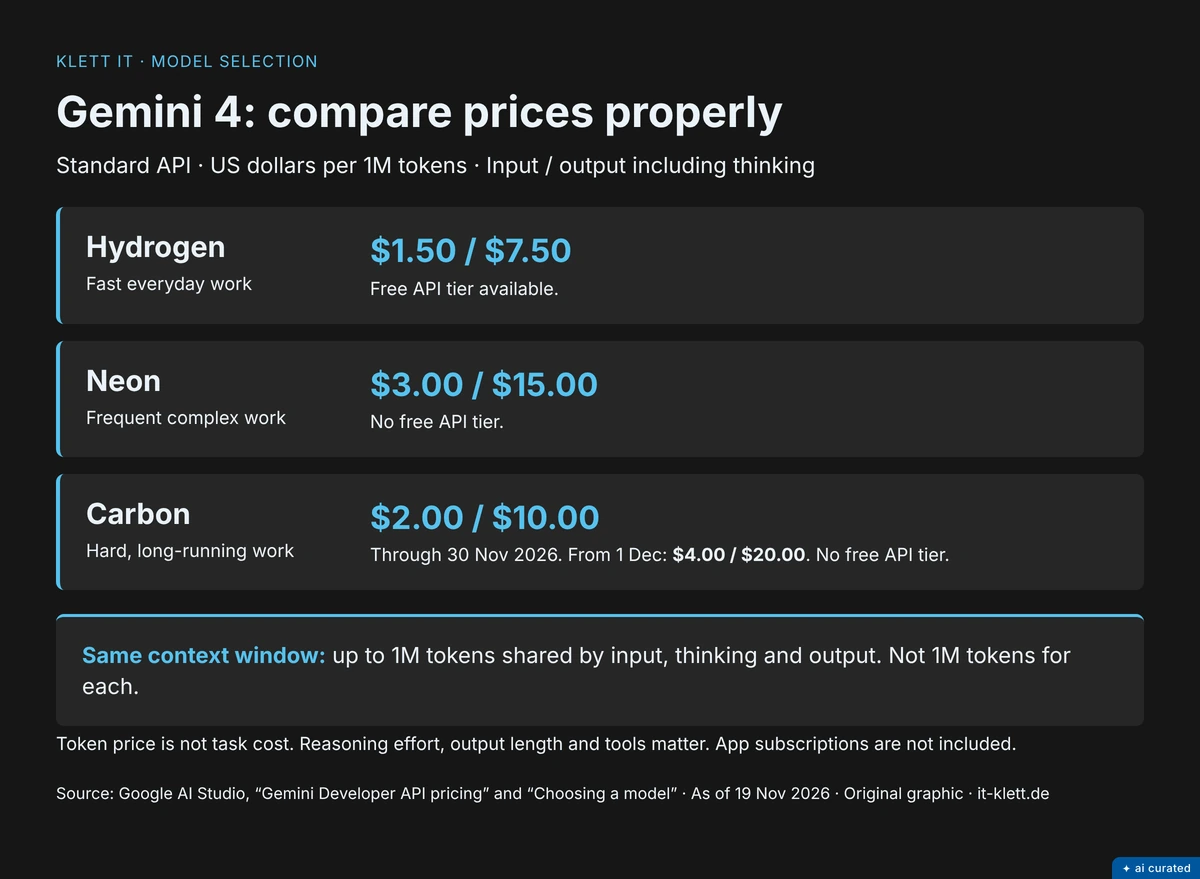
- In the Gemini API, Gemini 4 Neon costs 3 US dollars per 1 million input tokens and 15 US dollars per 1 million output tokens. Hydrogen costs half that, while Carbon rises from 2/10 to 4/20 US dollars on 1 December 2026. [1] [5]
- All three models share a context window of up to 1 million tokens for input, thinking and output. Google recommends Hydrogen as the default, Neon for complex, frequent tasks and Carbon for the hardest problems. [4]
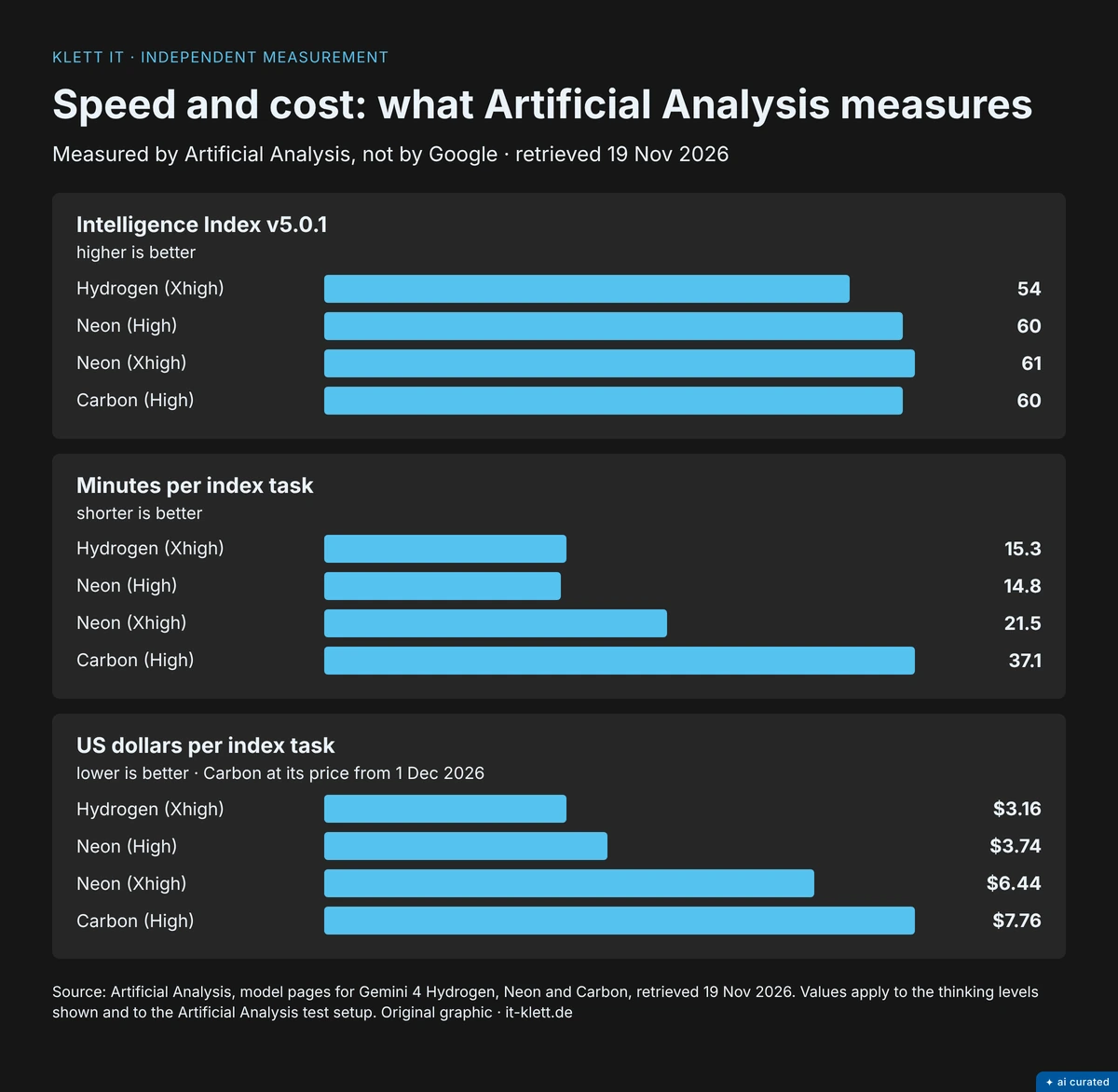
- Artificial Analysis measures 61 points in its Intelligence Index for Neon at the highest thinking level, Carbon scores 60 and Hydrogen 54. Neon needs 21.5 minutes per test task on average, Carbon 37.1 minutes (retrieved 19 Nov 2026). [13]

Within nine days, Google made three models of the Gemini 4 line broadly available: Carbon on 10 November, Hydrogen on 12 November and Neon on 18 November 2026. [7] [6] [1] I wrote about Carbon at the end of October, when only selected security teams were allowed to use it: Gemini 4 Carbon: what Google’s new AI model means for SMEs. A lot has shifted since then. So in this post I look at the whole family instead of covering each model separately.
The Gemini 4 family at a glance
| Model | US dollars per 1M tokens | Role according to Google |
|---|---|---|
| Hydrogen | 1.50 / 7.50, free tier available | Default for everyday work, code and agents |
| Neon | 3 / 15 | Complex, frequent tasks |
| Carbon | 2 / 10 until 30 Nov 2026, from 1 Dec 4 / 20 | The hardest problems |
All three share a knowledge cutoff of March 2026 and the same context window. They differ in thinking levels: Hydrogen and Neon offer low, medium, high (default) and xhigh, Carbon offers low, medium (default) and high. In the Gemini app, all users get Hydrogen, free accounts through automatic model selection. Neon is available there from Google AI Pro, Carbon only with Google AI Ultra. [1] [2] [4] [6] [7]
A token is a chunk of text, roughly part of a word. The context window defines how much material a model takes into account in a single request. Important: with Gemini 4, input, thinking steps and answer all share this one window of just over 1 million tokens. A single answer is normally limited to around 64,000 tokens, longer outputs only work through a background mode. [3]
What is Gemini 4 Neon?
According to its model card, Neon is derived from Carbon. Google describes it as a model for demanding coding, analytical reasoning and productive enterprise workflows. It is meant to finish faster than Carbon and use fewer output tokens, yet solve harder tasks than Hydrogen. [2] [4]
Google cites a number of its own results. In the Artificial Analysis Intelligence Index, Neon reaches 61 points at the highest thinking level, which Google calls third place. In the Vals Index it ranks second with 70.9 per cent, and first in the Artificial Analysis Coding Agent Index with 58.6 points. At the default level, a task is said to cost 32 per cent less than with Carbon. The post does not say which Carbon setting Google uses for this comparison. [1]
In the Gemini app, Neon is meant to help above all with knowledge work: reading spreadsheets, PDFs and photos more accurately, condensing dense material into reports and drawing on current web sources for fast-moving topics. Google gives comparing prices from several vendors before a bigger purchase as an example. [1] According to 9to5Google, Neon replaces both Argon and the older Gemini 3.1 Pro in the app. [14]
Hydrogen and Carbon: the other two tiers
Hydrogen succeeds Gemini 3.8 Flash and is the only one of the three models with a free API tier. According to Google, it completes tasks at the default level 2.5 times faster than its predecessor and invents statements more than five times less often. It also runs in Google Search. [6] One important detail: on the free tier, Google may use your inputs to improve its products, on the paid tier it may not. [5]
Carbon has been available via the API to all paying developers and enterprises since 10 November, and to Google AI Ultra subscribers. Google recommends it for tasks that push a model to its limits, such as complex debugging across many files or open research questions. To check thoroughly, it deliberately uses more tokens. [7] The introductory price applies until 30 November 2026. [5]
This leads to a calculation that is easy to miss: until the end of November, Carbon is cheaper per token than Neon. From 1 December this flips, and Carbon then costs 4 instead of 3 US dollars per 1 million input tokens and 20 instead of 15 US dollars for output. [5]
What Artificial Analysis measures
Artificial Analysis tests models with its own benchmarks, independently of the vendor. The following figures come from the model pages, which I retrieved on 19 November 2026. Each applies to the thinking level shown. [13]
| Model, level | Index | Time and cost |
|---|---|---|
| Hydrogen Xhigh | 54 | 15.3 min, 3.16 US dollars |
| Neon High | 60 | 14.8 min, 3.74 US dollars |
| Neon Xhigh | 61 | 21.5 min, 6.44 US dollars |
| Carbon High | 60 | 37.1 min, 7.76 US dollars |
Notably, Neon already matches Carbon’s score at the default High level and needs less than half the time to do so. For output speed, Artificial Analysis measures 169 tokens per second for Hydrogen, 110 for Neon and 55 for Carbon. For the whole index, Hydrogen produced 304 million, Neon 283 million and Carbon 205 million output tokens. The median of comparable models is 65.1 million. [13]
Good to know: third place or sixth?
Google writes that Neon ranks third in the Intelligence Index. When I retrieved it, the Artificial Analysis model page showed rank 6 of 96. Neither page explains the difference. Rankings also change with every new model. Carbon now stands at 60 points in index v5.0.1; my post from 29 October still showed 59 points in index v5.0. [1] [13]
My take: all three models are very verbose. For the index, Hydrogen and Neon produce more than four times as many output tokens as the median. A low token price can therefore get more expensive than the price list suggests. And even a top model can hallucinate, as Google itself states in the model card. [2] [13]
Which model for what?
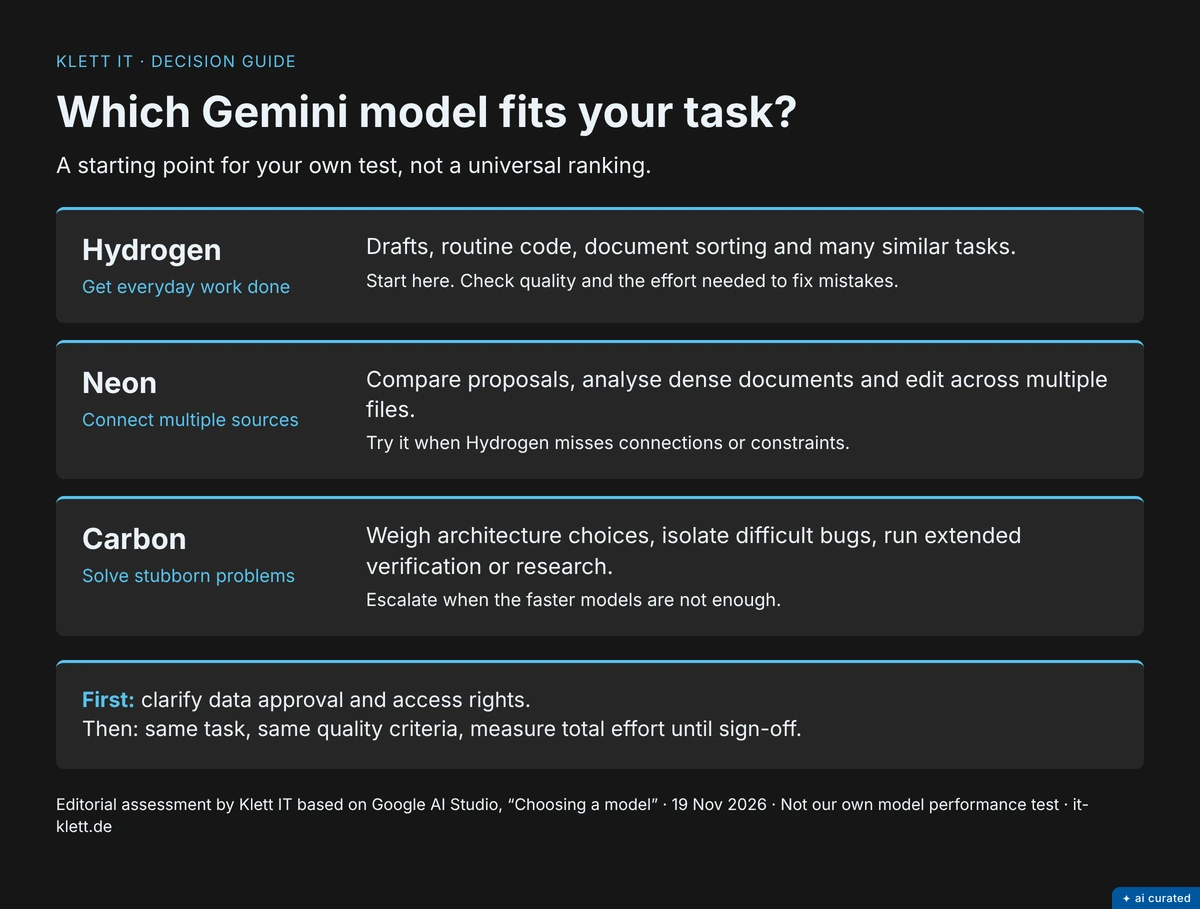
Google’s developer documentation sets a clear order: start with Hydrogen. Use Neon when Hydrogen is not enough and you do not need Carbon’s extra verification loop. Turn to Carbon for architecture questions, stubborn debugging, security reviews or when a faster model gets stuck. [4]
A second piece of advice from the same documentation often saves more money than switching models: set the thinking level first. Google recommends testing your own tasks at every level and then choosing the lowest one that meets your quality bar. The xhigh level exists only for Neon and Hydrogen. [3] [4]
Where you can use which model
- Gemini app: Hydrogen for everyone, Neon for Google AI Pro and Ultra, Carbon for Google AI Ultra. [1] [6] [7]
- Gemini for business: all three via the API or the model selector. [1] [6] [7]
- Google Cloud: Neon has been generally available since 18 November, according to Google for verified enterprise customers in selected regions. A global option and the US and EU multi-regions are listed. Besides PDFs, Neon also reads Word, Excel and PowerPoint files there. [10]
- GitHub Copilot: Neon has been enabled for the Pro+, Max, Business and Enterprise plans since 18 November, with a gradual rollout. [11] Argon will be removed there on 14 December 2026, and GitHub names Carbon as the replacement. [12]
What does this mean for SMEs and Microsoft Copilot users?
The following assessment is my own view based on the sources listed.
- Microsoft Copilot stays as it is: if your company works with Microsoft Copilot, Neon changes nothing. The Gemini models run in Google’s services. None of the sources evaluated here announces an integration into Microsoft Copilot. If you want to test Gemini as well, you need a separate Google account and your own data protection review.
- Check GitHub Copilot: if your development team uses GitHub Copilot Business or Enterprise, Neon is enabled automatically unless the admin has switched off the global default. Billing follows the vendor’s list price. Check the model policy before the costs surprise you. [11]
- Free does not mean confidential: Hydrogen’s free tier is fine for trying things out with sample texts. Customer data does not belong there, because Google may use the inputs to improve its products. [5] What you should clarify before using it is covered in May I enter customer data into an AI?
- Clarify data location: in Google Cloud, all three models are also listed in the EU multi-region. Whether that is enough for your contract and your data is something IT and data protection should decide together. [10]
- Test yourself instead of trusting rankings: take three real tasks from your daily work, let Hydrogen and Neon solve them and measure how long it takes to get a usable result. Only when both fail is Carbon worth it.
This post gives a general overview of the legal situation and is not legal advice. For your individual case, please talk to a lawyer or your data protection officer.
Media tip: further listening and reading
🎧 Podcast: heise KI-Update, 13 November 2026 (in German). The episode presents Hydrogen as a fast, low-cost everyday model and places it alongside Argon and Carbon.
🎧 Podcast: heise KI-Update, 11 November 2026 (in German). The episode covers the broad release of Carbon and the swarm feature in Antigravity, including whether many agents pay off.
🎬 Video: Prompt Engineering on YouTube, 18 November 2026. The channel says it had early access and shows real Neon results instead of benchmarks, from 3D code to agents in the cloud (14 minutes).
🎬 Video: Google Antigravity on YouTube, 12 November 2026. A short demo of Hydrogen and Carbon sorting and fixing bugs together (2 minutes).
🎬 Video: The Google Cloud Show, 9 November 2026. Tulsee Doshi, product lead for the Gemini models at Google DeepMind, explains how Argon and Carbon were built and tested (41 minutes).
🎬 Video: AI Engineer on YouTube, 18 November 2026. Melvin Johnson of Google DeepMind talks about post-training Gemini 4 for real engineering work and, from minute 10:00, how to stop agents from cheating (18 minutes).
📰 Article: The Decoder, 18 November 2026 (in German). Matthias Bastian puts the prices of all four Gemini 4 models side by side in one table.
Frequently asked questions
What is the difference between Gemini 4 Neon, Hydrogen and Carbon?
Hydrogen is the fast default model for everyday tasks, Neon the middle model for complex, frequent tasks and Carbon the most thorough model for the hardest problems. All three share a context window of up to 1 million tokens. [4]
How much does Gemini 4 Neon cost?
Is Gemini 4 Neon better than Carbon?
Further reading and support
Want to know which AI model fits your tasks and test it properly? In AI consulting for SMEs we look at your workflows and data together. How other vendors are positioning themselves right now is covered in Claude Fable 5.2 and Mythos 5.2: what businesses should check now. If you stay with Microsoft Copilot, the Copilot Compass will help. Good sources for staying up to date yourself are collected in the AI media tips. Get in touch.
Sources
Retrieved 19 November 2026. All sources are in English, except The Decoder (German).
- Koray Kavukcuoglu (Google): Introducing Gemini 4 Neon, Google Blog, 18 Nov 2026.
- Google DeepMind: Gemini 4 Neon Model Card, 18 Nov 2026.
- Google AI Studio: What’s new in Gemini 4 Neon, developer docs.
- Google AI Studio: Choosing a model, developer docs.
- Google AI Studio: Gemini Developer API pricing, price list.
- Koray Kavukcuoglu (Google): Introducing Gemini 4 Hydrogen, Google Blog, 12 Nov 2026, updated 16 Nov 2026.
- Koray Kavukcuoglu (Google): Gemini 4 Carbon is now available, Google Blog, 10 Nov 2026.
- Google DeepMind: Gemini 4 Hydrogen Model Card, 12 Nov 2026.
- Google DeepMind: Gemini 4 Carbon Model Card, 10 Nov 2026.
- Google Cloud: Gemini 4 Neon, model page of the Gemini Enterprise Agent Platform, with the pages for Hydrogen and Carbon.
- GitHub Changelog: Gemini 4 Neon in GitHub Copilot, 18 Nov 2026.
- GitHub Changelog: Upcoming deprecation of selected GitHub Copilot models in December, 13 Nov 2026.
- Artificial Analysis: model pages Gemini 4 Neon, Gemini 4 Hydrogen and Gemini 4 Carbon, measurements retrieved 19 Nov 2026.
- Abner Li (9to5Google): Gemini 4 Neon launches: Carbon quality at Flash speeds, for AI Pro, 18 Nov 2026.
- Matthias Bastian (The Decoder): Google veröffentlicht Gemini 4 Neon als neues Frontier-Modell für komplexe Aufgaben, 18 Nov 2026.
Change log
- : First published
✨ Curated and generated with AI, finalized by a human ❤️