In brief: Customer data only belongs in an AI application if the specific use has been reviewed and approved within your business. What matters is the type of data, the purpose, the legal basis and the terms of the service you use. For many writing tasks, fictitious details or a shortened excerpt are enough.
By Alex Klett · Klett IT Beratung Research and legal status: 20 October 2026 · Reading time: approx. 6 minutes
A customer email should sound friendlier, a quote should become easier to understand, or a conversation should be summarised. The quickest route often seems to be: copy the text, paste it into the chat, done. Before you do, it is worth taking a quick look at which information is actually being transferred.
Which data are we actually talking about?
Personal data relates to identified or identifiable people. This can include names, personal email addresses and details about contact persons. Company information can also be confidential, even if it does not relate to any person. Passwords, API keys and recovery codes, on the other hand, are access credentials and should not be copied into a general AI chat.
For personal data, purpose limitation, data minimisation and an appropriate legal basis apply in particular. Depending on the provider’s role, data processing agreements and possible transfers to third countries need to be reviewed. Consent is not the appropriate or only legal basis for every use. What counts is the specific processing and its requirements. [1]
Seven everyday situations and a sensible approach
The following examples are fictitious. The recommendations are practical decision aids, not blanket legal approvals.
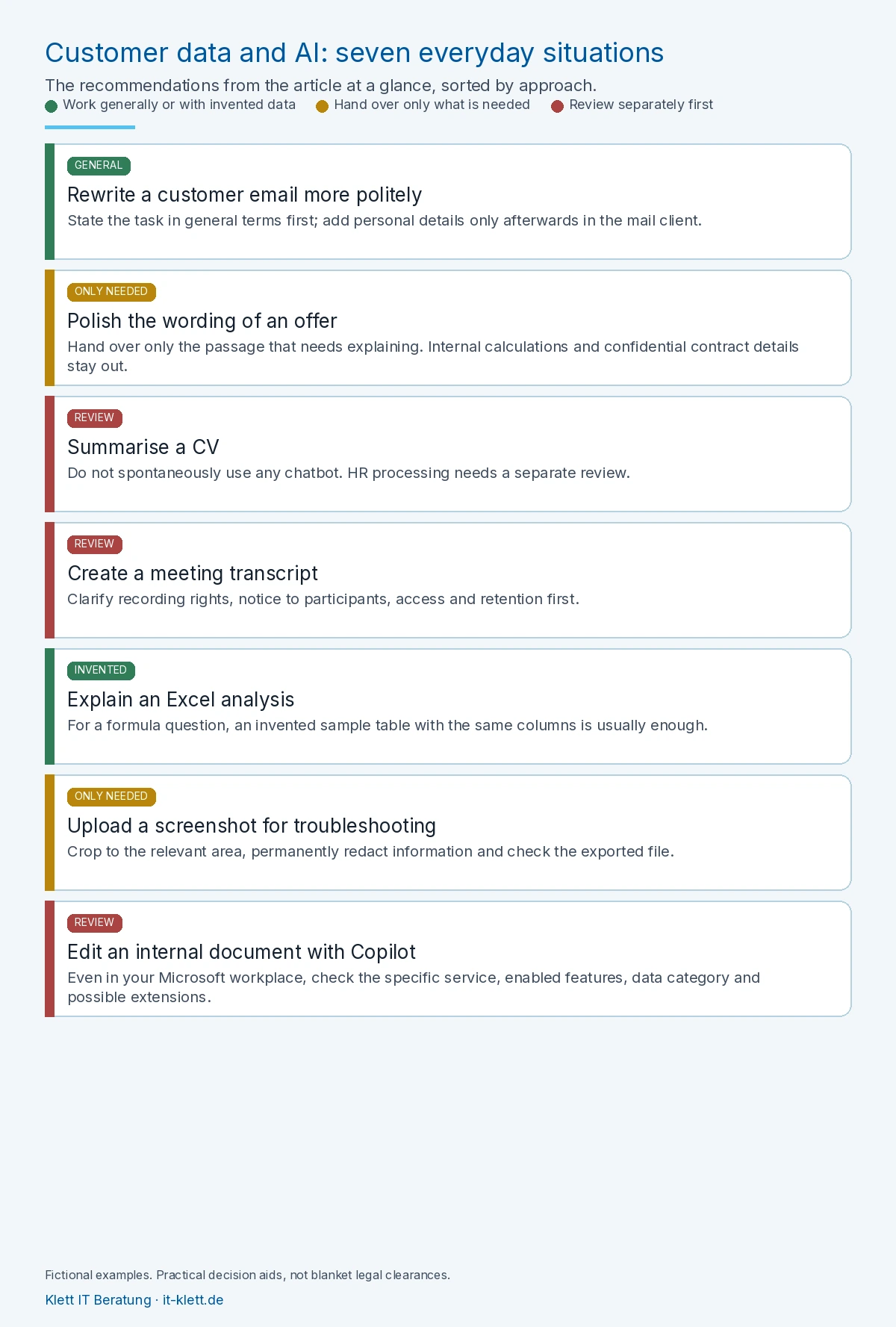
1. Making a customer email sound friendlier
Situation: A message contains a name, phone number, order number and the description of a complaint.
Recommendation: First phrase the task in general terms: “Write a polite reply about a delayed delivery.” If the original text is needed, remove unnecessary details and use only the environment approved for this purpose. Then add the personal details afterwards in your email program.
2. Improving the wording of a quote
Situation: The document contains customer-specific prices, discounts and technical details.
Recommendation: Only pass on the section of text that needs explaining. Internal calculations and confidential contract details stay out unless this use has been explicitly reviewed. Trade secrets can be affected even without names.
3. Summarising a CV
Situation: Incoming applications are to be screened more quickly.
Recommendation: Do not spontaneously use just any chatbot. Processing HR data requires a separate review. A linguistic summary must also be distinguished from an assessment or ranking. Applications often contain far more information than a single task requires.
4. Creating meeting minutes
Situation: A conversation is to be recorded, transcribed and summarised.
Recommendation: Clarify in advance whether recording is permitted, how participants are informed, who has access and how long data is kept. An already approved text assistant does not automatically mean approval for audio recordings. As a lean starting point, an employee can have their own factual notes structured, without unnecessary personal details.
5. Having an Excel analysis explained
Situation: The spreadsheet contains revenue figures for individual customers and contact details.
Recommendation: To ask about a formula, a made-up sample table with the same columns is usually enough. With real files, also check hidden worksheets, comments and metadata. The visible section is not always the entire content of the file.
6. Uploading a screenshot for troubleshooting
Situation: Besides the error message, customer names, browser tabs or an access key are visible.
Recommendation: Crop the relevant area and redact information permanently. Check the exported file. If a real secret has already been exposed, removing it from the image later is not enough: report the incident and have the affected access reviewed or replaced.
7. Editing an internal document with Copilot
Situation: The AI is already available in the company’s Microsoft environment.
Recommendation: Still review the specific service, the approved features, the data category and possible extensions. For the business Microsoft Copilot service, Microsoft describes, among other things, existing access permissions and that prompts and responses are not used to train foundation models. This does not replace a review of your own use; web search and connected services must be considered separately. [3]
Replacing names does not automatically mean anonymising
“Customer A” can still be recognisable if the project, location and background are unambiguous. Pseudonymised data remains personal data if it can be attributed to a person. True anonymisation requires that identification is no longer possible, taking into account the means reasonably likely to be used. [1]
My practical advice: if you only need the form, tone or structure, work with completely made-up examples. This is often simpler and more reliable than cleaning up an extensive original document afterwards.

Five questions before you paste
- Is exactly this application approved for this task?
- Which personal or confidential details are included?
- Which of them are really necessary for the result?
- Have processing, access, storage and deletion been clarified?
- Who checks the result before it is used?

The German Data Protection Conference (DSK) recommends clear rules for permitted applications and use cases, as well as involving the people responsible for data protection at an early stage. Its guidance also covers technical settings and the use of prompts for training purposes. [2]
What businesses can prepare now
Create a short internal overview: approved tools, permitted data, typical examples and a contact person who can be reached. Add a reporting channel for information uploaded by mistake. Employees need an answer they can understand in everyday work, so that they can ask in good time when they are unsure.
The current occasion: as part of Cyber Security Month 2026, the Swiss Federal Office for Cybersecurity is addressing the topic of oversharing and names internal documents in AI tools as a possible risk. The campaign provides illustrative examples; for the German legal framework, I use the EU and DSK sources listed below. [4]
Frequently asked questions
Is a paid AI automatically suitable for customer data?
No. The price says nothing about whether the contracts, technical settings and specific purpose of processing are appropriate.
Is it enough to switch off training use?
No. Storage, access, transfer and the legal basis for processing must also be taken into account.
Is data anonymous if I replace the name?
Not automatically. “Customer A” can still be recognisable if the project, location and background are unambiguous. Pseudonymised data remains personal data if it can be attributed to a person.
What should I clarify before pasting into an AI?
Is exactly this application approved for this task? Which personal or confidential details are included, and which of them are really necessary? Have processing, access, storage and deletion been clarified? And who checks the result before it is used?
Further reading and support
Terms such as prompt and language model are explained in my AI glossary. You can find the regulatory framework in the article on the EU AI Act for businesses. What Art. 88bis GDPR means for AI with customer data is explained in the article on the Digital Omnibus. How much a chatbot can infer about a person from many conversations is shown in my self-experiment How does ChatGPT see me? (in German).
Would you like to develop clear rules for AI in everyday work? Get in touch.
Sources
- GDPR, in particular Articles 4–6, 28, 32 and 44 et seq. as well as Recital 26.
- German Data Protection Conference (DSK): Guidance on artificial intelligence and data protection (in German), 6 May 2024.
- Microsoft Learn: Data, privacy and security for Microsoft Copilot. Manufacturer information; review the specific service terms separately.
- NCSC Switzerland (BACS): Cyber Security Month 2026 – Oversharing (in German), 5 October 2026.
✨ Curated and generated with AI, finalized by a human ❤️