As of: For: decision-makers · staff By Alex Klett · Klett IT Beratung Reading time approx. 11 minutes
In brief: AI and the job market are often mentioned in the same breath as job losses. The latest studies paint a more precise picture: in the US there is no broad AI-driven job loss so far. Young people starting their careers in highly AI-exposed occupations are having a harder time, however, mainly because fewer of them are being hired. Whether AI is the cause is disputed among researchers.
Key points at a glance
- In US payroll data through June 2026, the Stanford Digital Economy Lab finds no widespread job displacement from AI. For 22 to 25-year-olds in AI-exposed occupations, however, employment is 19 per cent below the path of less-exposed occupations, mainly because fewer are being hired. [3]
- A research team led by Morgan R. Frank shows in a preprint that outcomes in exposed occupations began to worsen in early 2022, before ChatGPT. The launch of ChatGPT is therefore not a clean point of comparison. [4]
- “Exposure” means that AI could technically speed up a task. It says nothing about layoffs. All studies are based on US data; none of them includes a comparable measurement for Germany. [1] [3]

This article was prompted by the heise KI-Update podcast of 16 November 2026 (in German). It covered an analysis by Australia’s central bank, a Stanford study and an objection from researchers in Pittsburgh. I read the studies behind it in the original and put them in context for you: what is proven, what is not, and what it means for your business. [6]
Four questions that often get mixed up
The debate about generative AI and jobs mixes up four questions. Each one needs a different kind of study:
- What could AI do technically? Exposure studies such as “GPTs are GPTs” estimate this. [1]
- What do workers want to hand over? Stanford’s WORKBank database asks them. [2]
- What is visible in the job market? Payroll data, as in “Canaries in the Coal Mine”, measure this. [3]
- Is AI the cause? The counter-study “AI-exposed jobs deteriorated before ChatGPT” tests this. [4]

What does “AI exposure” mean?
The best-known exposure study comes from researchers at OpenAI and Daniel Rock of the Wharton School at the University of Pennsylvania. They rated tasks from the US occupational database O*NET by whether a language model could roughly halve the time needed at the same quality. [1]
The result: around 80 per cent of US workers are in occupations where at least 10 per cent of tasks could be affected. For around 19 per cent it is at least half of the tasks. With a language model alone, about 15 per cent of all tasks could be done significantly faster. Including software built on top of such models, the share rises to between 47 and 56 per cent. [1]
What matters is what the study does not say. The authors explicitly make no prediction about when or how fast the technology will be adopted. Exposure means “could be faster”, not “will disappear”. The later short version in the journal Science reports different figures; I use the figures from the full version here. [1]
Australia’s central bank sums up the difference: high exposure does not imply displacement. Occupations in which AI could take over many tasks are often also those in which AI can support people most. [5]
What do workers want to hand over to AI?
A Stanford University team led by Diyi Yang and Erik Brynjolfsson turned the question around. For the WORKBank database, 1,500 workers from 104 occupations rated a total of 844 tasks from their daily work. AI experts also assessed what AI agents can technically do today. The study is a preprint and has not yet been peer-reviewed. [2]
- For 46.1 per cent of tasks, workers view automation positively, even after job loss and enjoyment of work had been raised. The most common reason: more time for higher-value work (69.38 per cent of responses). [2]
- In 45.2 per cent of occupations, an equal partnership between human and agent is the most desired level, not full automation. [2]
- The biggest concern is a lack of trust in accuracy and reliability (45.0 per cent), followed by the fear of being replaced (23.0 per cent). [2]
The comparison with start-ups is striking too: 41.0 per cent of the mappings of Y Combinator companies to tasks fall into areas that workers do not want automated or that have low priority. A tool that can technically do something does not automatically solve a problem in your team. [2]
What do US payroll data show about career starters?
The most important measurement comes from the Stanford Digital Economy Lab. Erik Brynjolfsson, Bharat Chandar and Ruyu Chen analyse anonymised payroll records from the US provider ADP covering millions of workers. The current version of 12 August 2026 runs through June 2026. It is a working paper, not a peer-reviewed journal article. [3]
- No broad job loss: across the whole sample, employment rose by about 6 per cent from November 2022 to June 2026, and by about 4 per cent in the most exposed fifth of occupations. [3]
- A gap for younger workers: for 22 to 25-year-olds in the two most exposed fifths, employment fell by about 11 per cent. In less-exposed occupations, it grew by about 10 per cent in the same age group. That results in the 19 per cent gap. [3]
- Less hiring, not more dismissals: the gap opens mainly because firms hire fewer young people. Base pay has hardly reacted so far. [3]
- Replace or complement: the declines affect mainly occupations where AI tends to take over human tasks. Where AI tends to support people, employment is stable or growing, especially for experienced workers. [3]
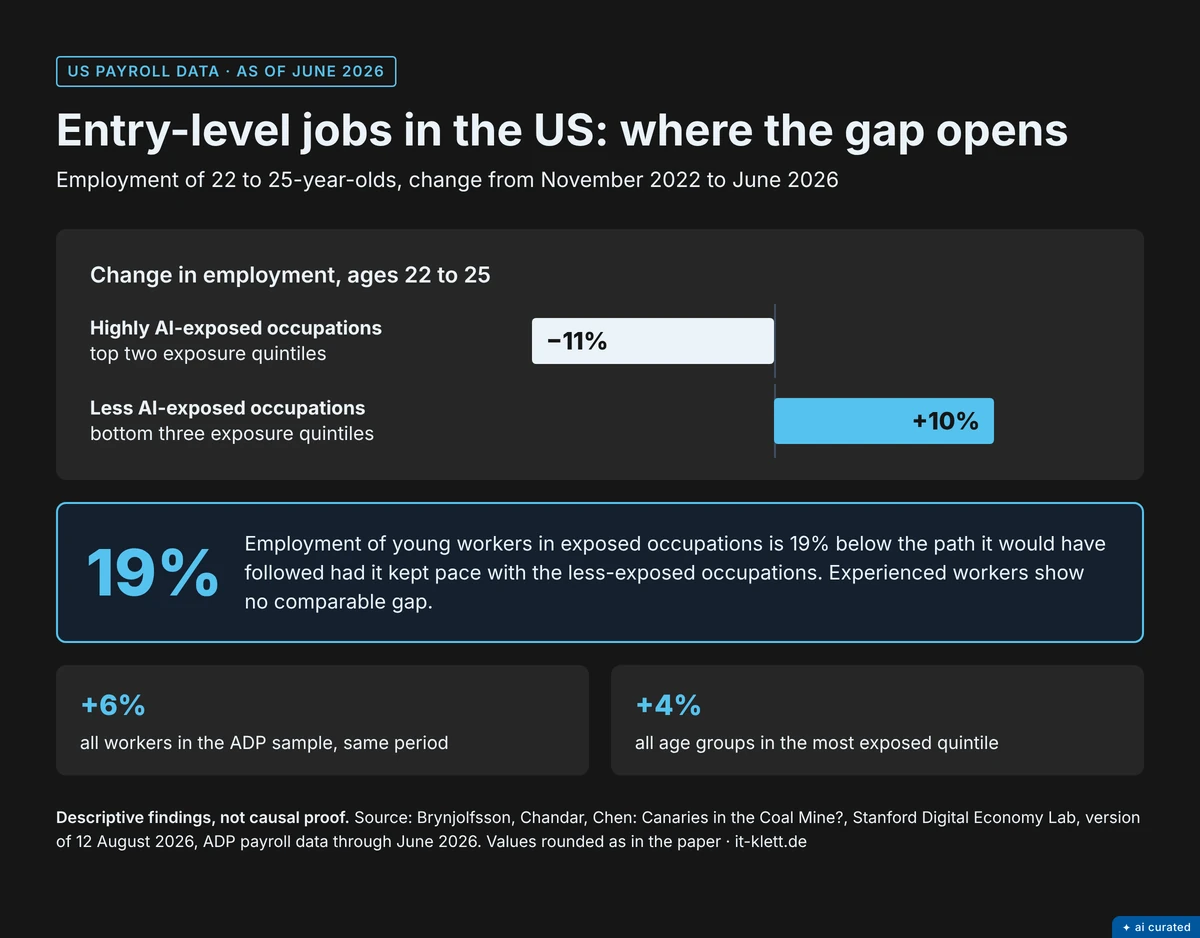
The figure has changed over time, by the way. Earlier versions reported 13 per cent (data as of July 2025) and 16 per cent (data as of September 2025). Those were regression estimates that adjusted for firm-level shocks. The new version puts the simpler descriptive gap first, which has grown from 15 to 19 per cent. If you see different percentages in the media, this switch is usually why. [3]
The authors themselves are cautious. They call their results early, descriptive indicators rather than causal estimates. Some trends were already diverging before ChatGPT, the effects weaken when education is taken into account, and they are more pronounced in the ADP sample than in national surveys. [3]
Why the counter-study from Pittsburgh disagrees
A team led by Morgan R. Frank took a different route. In the first version, Frank was at the University of Pittsburgh; the revised version lists Case Western Reserve University. Not to be confused with the University of Pennsylvania from the exposure study. The paper is a preprint, first published on 5 January 2026 and revised on 16 October 2026. [4]
- Monthly US unemployment insurance data show that unemployment risk in AI-exposed occupations began to rise in early 2022, months before ChatGPT. [4]
- Millions of LinkedIn profiles show that graduate cohorts from 2021 onwards entered exposed jobs less often, with the gap opening before late 2022. [4]
- Millions of university syllabi show that graduates whose studies included more content relevant to language models found their first job faster after ChatGPT and earned more when starting in highly exposed occupations. [4]
As possible earlier influences, the team names the US Federal Reserve’s interest rate turn from March 2022 and the cooling after the pandemic hiring boom. It explicitly flags a US tax rule that has made development salaries more expensive since 2022 as a hypothesis. The team stresses that it identifies the timing, not the cause. [4]
Good to know: do the studies contradict each other?
Only partly. Both see weaker outcomes for young people in exposed occupations. The cause is what is disputed. The Stanford team accounts for interest rates and remote work, excludes technology firms and still sees the gap growing, but acknowledges earlier trends. The Pittsburgh team shows that the deterioration began before ChatGPT. [3] [4]
My take: the data cover different periods. Frank’s unemployment data run to October 2025 and the LinkedIn job starts to December 2024. The Stanford data run to June 2026 and show that the gap has kept widening since August 2025. An earlier trend from 2022 and a later amplification are therefore not mutually exclusive. Neither paper provides causal proof. [3] [4]
Australia: same direction, same caution
The hook for the KI-Update episode was an analysis that Mike Major published for the Reserve Bank of Australia on 9 November 2026. His finding: so far there is little evidence that AI has materially changed the Australian labour market. In more exposed occupations there are tentative signs of weaker outcomes, especially for younger people. [5]
Major explicitly measures potential, not actual use in firms. The economic cycle and changes in how people work after the pandemic could also be driving the figures. He also points out that conditions for young workers in Australia remain stronger than before the pandemic. [5]
Can the figures be applied to Germany?
Not directly. All the studies discussed here are based on US data: US occupational categories, US payroll records, US unemployment insurance, LinkedIn profiles and US syllabi. The German labour market is organised differently, for example through its dual vocational training system. These studies do not answer whether the same patterns appear there. A German study with a comparable design was not part of my review.
In the KI-Update of 24 August 2026 (in German), heise also refers to an Ifo survey and a reply from the German Federal Ministry of Labour. I have not checked these sources in the original, so I do not quote any figures from them here.
What you can do as a business now
The studies give no reason to panic, but they do give a clear signal: in the US data, the career entry point comes under pressure first, not the experienced workforce. If you hand routine tasks to Microsoft Copilot or an AI agent, you save time in the short term. In the long term, however, you lose the practice tasks that new staff learn from. These steps help:
- Look at tasks, not positions: list the typical tasks of your entry-level roles and ask the people involved what they would like to hand over. That is exactly how WORKBank works. [2]
- Complement rather than replace: use AI first where it supports people. In the Stanford data, that is exactly where employment stays stable or grows. [3]
- Rebuild learning paths: when Microsoft Copilot writes the first draft, the junior employee reviews it and an experienced colleague signs it off. That keeps learning in the workflow. It follows the human in the loop principle.
- Build AI literacy: Article 4 of the AI Act requires measures to build your staff’s AI literacy. How to get started is covered in AI literacy in your business: how to get started the right way.
- Keep hiring juniors: if you cut junior positions today, you may have too few experienced specialists in a few years. That is not a study figure but a trade-off you should make deliberately.
For the first step you can use Microsoft Copilot. Paste the tasks of a role as a list and let it sort them. Do not enter any personal data.
Here is a list of tasks from an entry-level role in our company. Assign each task to one of three groups:
1. AI can prepare it, a person reviews and signs it off.
2. AI supports, the person does the work.
3. Stays with a person, because experience, responsibility or customer contact come first.
Justify each assignment in one sentence. For each task, also state what a junior employee learns from it and how that learning effect can be kept if AI takes over part of it.
Tasks:
[Insert task list]
Media tip: further listening and reading
🎧 Podcast: heise KI-Update, 16 November 2026 (in German). From minute 5:57, the episode summarises the Australian central bank’s analysis and sets the Stanford study and the objection from Pittsburgh alongside it.
🎧 Podcast: heise KI-Update, 24 August 2026 (in German). From minute 5:51, it covers the updated Stanford analysis with payroll data through June 2026.
🎬 Video: Stanford Digital Economy Lab on YouTube, 30 September 2025. Bharat Chandar and Ruyu Chen present “Canaries in the Coal Mine” themselves in a seminar, still with data as of July 2025.
🎬 Video: PBS Dream Machines, 14 August 2026. Erik Brynjolfsson talks about the Canaries study, young workers and career paths (35 minutes).
📰 Article: heise online, 19 August 2026 (in German). Stefan Krempl reports on the updated Stanford study and the 19 per cent gap.
📰 Article: The Decoder, 15 November 2026 (in German). Manuel Uth summarises the Australian analysis and sets other studies alongside it. The 13 per cent quoted there comes from the first Stanford version of 2025.
Frequently asked questions
Is AI already destroying jobs?
US payroll data through June 2026 show no widespread job loss. Total employment in the sample has risen by about 6 per cent since November 2022. Employment of 22 to 25-year-olds in highly AI-exposed occupations is developing more weakly. [3]
What does the 19 per cent gap mean?
Employment of young people in AI-exposed occupations is 19 per cent below the level it would have reached had it grown as in less-exposed occupations. It is a descriptive figure for the US, not causal proof. [3]
Why does the Pittsburgh study doubt that AI is the cause?
Because unemployment risk in exposed occupations began rising in early 2022, before ChatGPT. Graduate cohorts from 2021 onwards were also already entering exposed jobs less often. The paper is a preprint. [4]
Further reading and support
Do you want to introduce AI so that it takes work off your team while new staff still learn? With AI consulting for SMEs, we look at your tasks and roles together. Training on AI literacy under Article 4 of the AI Act is part of the EU AI Act consulting. How AI agents work in a business is explained in AI agents explained. Get in touch.
Sources
Studies and analyses in the original, accessed on 17 November 2026.
- Eloundou, Manning, Mishkin, Rock (OpenAI, University of Pennsylvania): GPTs are GPTs: An Early Look at the Labor Market Impact Potential of Large Language Models, arXiv 2303.10130, version 5. Short version in Science, vol. 384, 2024.
- Shao, Zope, Jiang, Pei, Nguyen, Brynjolfsson, Yang (Stanford University): Future of Work with AI Agents: Auditing Automation and Augmentation Potential across the U.S. Workforce, arXiv 2506.06576, preprint, version 3 of 1 February 2026.
- Brynjolfsson, Chandar, Chen (Stanford Digital Economy Lab): Canaries in the Coal Mine? Six Facts about the Recent Employment Effects of Artificial Intelligence, working paper, version of 12 August 2026 (PDF).
- Frank, Javadian Sabet, Simon, Bana, Yu: AI-exposed jobs deteriorated before ChatGPT, arXiv 2601.02554, preprint, version 1 of 5 January 2026, version 2 of 16 October 2026.
- Mike Major (Reserve Bank of Australia): Monitoring Early Effects of AI on the Labour Market, RBA Insight 2026-09, 9 November 2026.
- heise online: KI-Update kompakt: Nvidia-Drama, Berufseinstieg, Siri AI, Home Assistant mit KI, companion text to the podcast episode, 16 November 2026 (in German).
Change log
- : first published
✨ Curated and generated with AI, finalized by a human ❤️