As of: For: everyone who uses AI or is curious about it By Alex Klett · Klett IT Beratung Reading time approx. 9 minutes
What mattered this week – and what it means for you
Welcome to the first edition of the AI Weekly Compass! Once again, a lot happened in AI in the week from 2 to 6 November 2026. I have picked out five news items and put them into context: what is behind them, what affects you, and what can you do now? Editorial deadline was midnight on Thursday, 5 November 2026.
Key points at a glance
- Microsoft has announced that Claude in Microsoft Copilot is to run within the EU Data Boundary by the end of 2026. Today, this is not yet the case [1] [2].
- In thousands of apps built with Lovable, data could be read without logging in. Built quickly does not automatically mean secure [3].
- AI now finds security vulnerabilities in large numbers, for defenders and attackers alike. Current updates are becoming even more important [5] [6].
1. Claude in Microsoft Copilot is to move into the EU Data Boundary
What’s happening
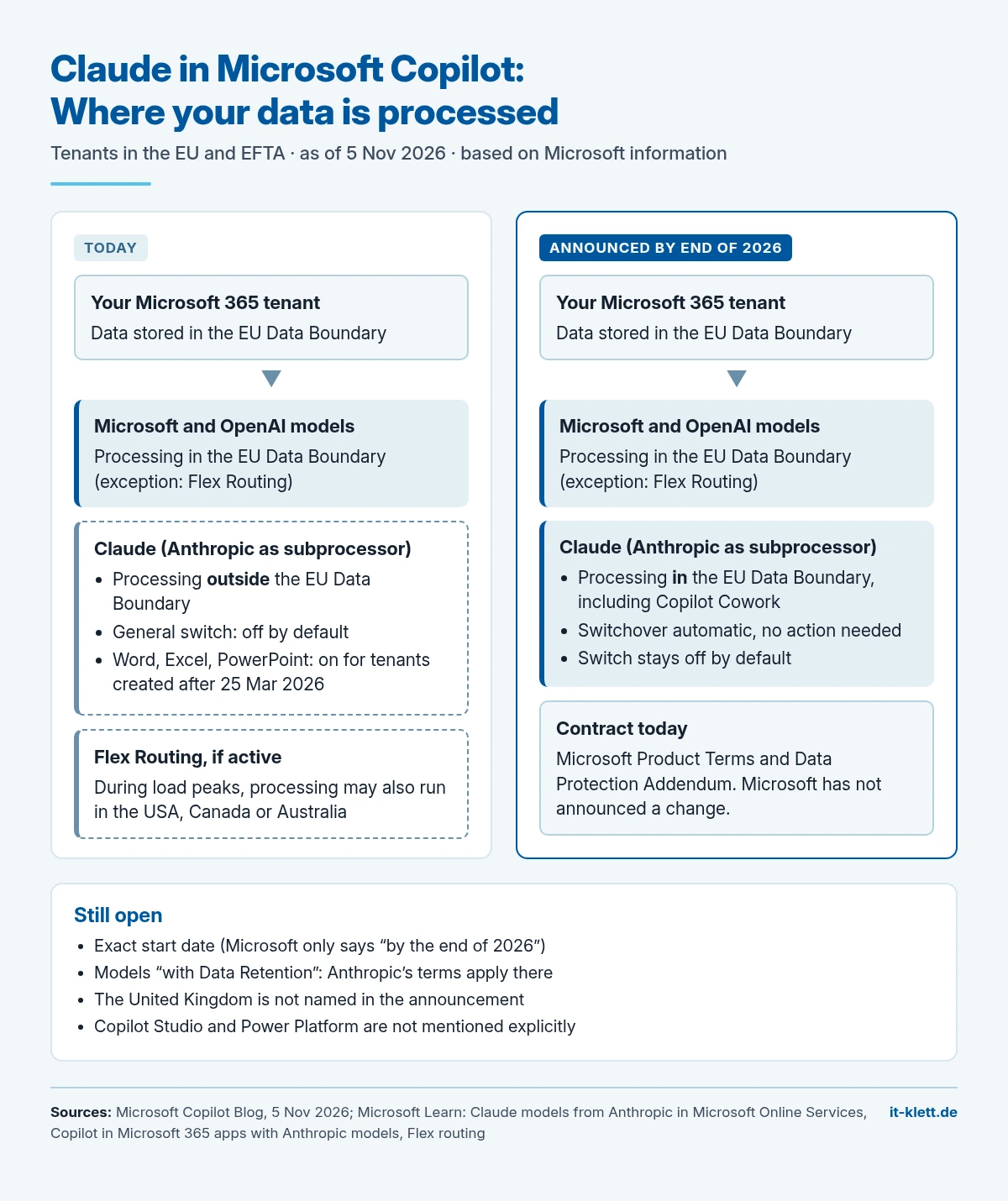
Microsoft Copilot is the AI assistant in Microsoft 365, for example in Word, Outlook and Teams. It can also use Claude, the AI model from the company Anthropic. On 5 November 2026, Microsoft announced: by the end of 2026, Claude in Copilot is to be processed within the EU Data Boundary, including in Copilot Cowork [1]. This is Microsoft’s commitment to store and process data from customers in the EU and EFTA within this region.
Today, this does not yet apply. According to Microsoft’s documentation, the Anthropic models are excluded from it and are switched off by default in the EU, the EFTA and the United Kingdom [2]. Microsoft has not given an exact start date.
Why it matters
If you use Claude in Copilot in the EU, your data is currently processed outside the EU Data Boundary. If the announced move happens, this technical point changes. Other questions, such as the contract, data protection and internal rules for AI, remain independent of this and still need to be reviewed.
What you can do now
Privately, you do not need to do anything. If you use Copilot at work and are unsure whether Claude is allowed in your organisation, briefly check with your IT department. How the Copilot variants differ is shown in the Copilot map 2026.
Good to know: if you manage Microsoft 365
You can find the switch for Anthropic models in the Microsoft 365 admin center. Check whether it is on or off and for whom, and record the decision. Until the switchover, Anthropic remains a subprocessor with processing outside the EU [2]. Whether anything needs to be changed at launch can then be found in Microsoft’s documentation. Put a reminder in your calendar for early 2027.

2. Apps built with AI: data often readable without logging in
What’s happening
With services like Lovable, you build apps and websites by describing to the AI what you want. This is called vibe coding. The Hamburg-based security company Crissy Field, together with the German business newspaper Handelsblatt, examined 159,041 such projects [3] [4]. On 7,403 of 24,664 websites examined more closely, tables with email addresses could be read without logging in.
In individual cases, even passport numbers, payment and ticket data, contracts and over 200,000 chat messages were exposed. The cause was not a break-in, but missing or overly lax access rules in the database. The researchers emphasise: the roughly 30 per cent is not a confirmed leak rate, and the sample is not representative.
Why it matters
Such apps are built quickly, for example a registration form for a club or a booking page for a side business. According to the terms of use, whoever runs the app is responsible for the data in it, not the platform [3]. And anyone who enters data into such a form cannot see from the outside how well it is protected.
Caution
The problem does not only affect Lovable. Any quickly built app with its own database can have the same gap, regardless of whether a human or an AI wrote it.
What you can do now
Have you built such an app yourself? Then check what a visitor can see without logging in, or have it checked by someone who knows about database access rules. Real data of other people should only go in once this has been clarified.
If you run such an app professionally: If customer data is exposed there, this can be a reportable data breach. In that case, talk to your data protection officer promptly. More on this in the article Entering customer data into AI.
3. AI finds security vulnerabilities, for defenders and for attackers
What’s happening
On 4 November 2026, OpenAI presented an automated system that uses a not yet released AI model to search the Linux kernel, the core of many servers and network devices. It found 948 ways in which someone could obtain administrator rights, reproduced them and proposed fixes. The cost of using the AI was around 1.2 million dollars [5]. People check the results before they go to the Linux developers.
At almost the same time, the documentation platform GitBook reported an attack on 2 November 2026 which, according to GitBook, was largely automated and AI-assisted [6]. GitBook revoked all API tokens, i.e. the digital keys with which other programs access an account. Customers are asked to renew connected keys.
Why it matters
OpenAI itself writes: for well-resourced attackers, a system without current updates is practically as open as admin access [5]. And every service you connect to other tools via a key is a possible point of attack.
What you can do now
Switch on automatic updates wherever possible: on your phone, laptop, router and NAS, if you have one. Have you connected AI tools to other services, such as your email account or cloud storage? Then check from time to time which connections exist and remove what you no longer need.
Good to know: if you look after IT at work
Keep servers, NAS systems and routers up to date. Keep a simple list of which API keys and connections to AI tools exist and who can renew them. If you use GitBook, renew the connected keys [6]. The basics are covered in IT security at the office.
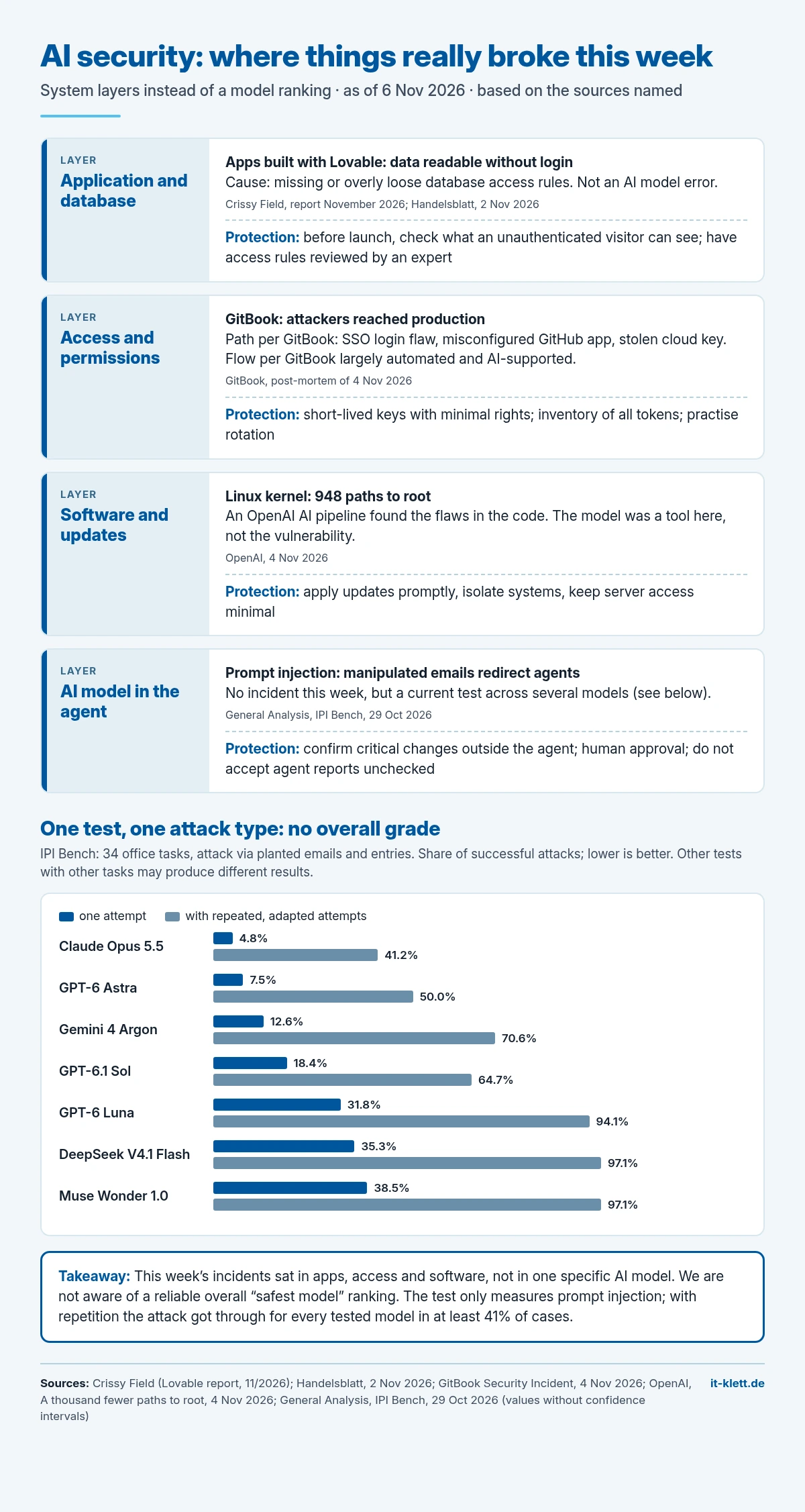
These examples concern different system layers: with Lovable, the application’s access rules; with GitBook, access and keys; with the Linux kernel, the program code. This does not result in a security ranking of AI models, and I am not aware of any independent test that ranks models overall in this way.
However, a current test on prompt injection shows something important [11]. This is where someone hides instructions to the AI, for example in an email. All seven models tested could be made to carry out harmful actions with such planted emails, with repeated attempts in at least 41 per cent of cases. If you let an AI read emails or do things for you, it is better to confirm important steps yourself.
4. CJEU Advocate General: how far may chatbots reproduce press articles?
What’s happening
The first case on generative AI is under way at the Court of Justice of the European Union: Like Company v Google, concerning the chatbot Gemini (Case C-250/25). On 3 November 2026, Advocate General Maciej Szpunar delivered his opinion [7]. An Advocate General is a kind of independent expert adviser to the court. He proposes a solution, but the court does not have to follow it.
His assessment: training AI with protected content is in principle permissible under the exception for text and data mining. However, if a chatbot retrieves articles in real time and adopts their form of expression in such a way that the original is no longer needed, or if it circumvents a paywall in the process, this may infringe the rights of press publishers. This is not a judgment; that is still pending.
Why it matters
The case will help clarify how much of other people’s articles may be contained in an AI answer. If you reuse AI answers, for example for a newsletter, a club website or your blog, the question of the rights to them is still open.
What you can do now
Treat AI answers about news as a starting point, not as finished text. Write it in your own words, name the original source and do not copy longer passages. You can find more about the obligations when using AI in businesses under EU AI Act for businesses.
This article gives a general overview of the legal situation and does not replace legal advice. For your individual case, please talk to a lawyer or your data protection officer.
5. Mistral: AI agents that ask before important steps
What’s happening
AI agents are AI programs that do not just answer but carry out tasks themselves. On 5 November 2026, the French provider Mistral released Managed Agents as a public preview [8]. The agents run either in your own program, on your own servers or at Mistral. They work in the background for hours or days and, after a crash, continue from the last completed step. Individual actions can be set so that they only run after a human has approved them. Every step is logged.
Why it matters
The more an AI does on its own, the more important two questions become: who allowed the step? And can you trace afterwards what happened? Approval, logging and the choice of where it runs address exactly these points.
What you can do now
It is a preview. You do not need to do anything for your everyday life right now. If you develop software, you can try out the agents for testing. Whichever AI helper you use: pay attention to whether it asks before important actions and whether you can see what it has done.
If you are planning AI agents at work: approval before critical actions, a complete log and the place of operation belong on the list of requirements. Why responsibility still remains with you is explained in Who is liable when AI agents make mistakes.
Tip from practice: the tip of the week
Do you have a WordPress website, for example for a club, blog or business? Then take a quick look today. The US authority CISA has listed a WordPress vulnerability as actively exploited since 3 November 2026 [9]. Versions 4.7 to 7.1.3 are affected; it is fixed in WordPress 7.1.4 from October [10]. A look in the dashboard under “Updates” is enough. If your hosting provider or an agency looks after the site, ask them.
Outlook
Microsoft intends to announce the exact start date for Claude in the EU Data Boundary later. In CJEU case C-250/25, the judgment will only follow in a few months. We will keep an eye on both for you.
Are you wondering what this means specifically for you or your work? Call me on +49 174 829 9329 or write to me via the contact form.
Sources
- Microsoft Copilot Blog, Charles Lamanna: Bringing Claude models in Microsoft Copilot into the EU Data Boundary, 5 November 2026.
- Microsoft Learn: Anthropic models in Microsoft Online Services, accessed on 5 November 2026.
- Crissy Field GmbH: Lovable: numerous apps created with it expose sensitive data (in German), November 2026.
- Handelsblatt, Lina Knees: Lovable: experts find data gap in popular AI coding platform (in German), 2 November 2026.
- OpenAI: A thousand fewer paths to root, 4 November 2026.
- GitBook: Security incident, post mortem of 4 November 2026.
- Court of Justice of the European Union, press release no. 155/26 on the opinion in Case C-250/25 (German version), 3 November 2026.
- Mistral AI: Release Notes, Managed Agents, 5 November 2026.
- CISA: CISA Adds One Known Exploited Vulnerability to Catalog, 3 November 2026.
- WordPress.org: WordPress 7.1.4, October 2026.
- General Analysis: IPI Bench, Indirect prompt injection against workplace agents, 29 October 2026, checked on 4 November 2026.
- Anthropic: Data Processing Addendum, effective from 24 February 2025.
- Anthropic Privacy Center: Where are your servers located? Do you host your models on EU servers?, 15 June 2026.
- Claude by Anthropic: Regional compliance, accessed on 5 November 2026.
✨ Curated and generated with AI, finalized by a human ❤️