Updated: For: anyone interested By Alex Klett · Klett IT Beratung Reading time approx. 13 minutes
In brief: “Wall” is track 1 of my private DJ project trayback. This peak-time techno track was created with Suno on 24 November 2026 and then finished as a DJ edit with a public-domain archival voice. In this post I walk through the process: describing the sound in words, clearing the rights, comparing tempos, and mastering at −10 LUFS.
The essentials in brief
- “Wall” opens the planned trayback short album. It is peak-time techno, runs at 135 BPM, lasts 5:04 and is mastered at −10.0 LUFS. Seven pieces are planned, four with a voice and three without. I will handle distribution myself, later including Spotify. [1]
- The voice is not generated. It comes from Ronald Reagan’s address at the Brandenburg Gate on 12 June 1987. The White House Communications Agency recorded it, and it is archived under NARA NAID 7087579. In the United States it is a work of the US government and is not subject to copyright under 17 U.S.C. § 105. [2] [3]
- I generated the instrumental bed with Suno at several tempos, chose the 135 BPM version, downloaded it as a WAV and built a DJ edit. The documented steps used around 55 credits and one download during an active Pro subscription. Suno ties commercial use to a permitted download on a paid plan. [1] [4] [5]
What trayback and “Wall” are
trayback is my DJ name and a private artist project. It is not the Klett IT brand. The plan is a short album of seven tracks, four with vocals and three instrumental. Track 1 is called “Wall”.
The finished version runs 5:04.100 and sits at a fixed 135.000 BPM. As a key for orientation I noted A minor (8A); you should confirm that in your DJ software. The track is mastered at −10.0 LUFS integrated, with a true peak of −1.6 dBTP in the WAV and −1.3 dBTP in the MP3. The master is 48 kHz, 24-bit. [1]
Describing the sound in words, without artist names
I wanted to continue with peak-time techno: hard, driving, suitable for clubs and festivals. The public texts and the prompts deliberately contain no artist or label names. There are two reasons. Generation tools often block such names or produce unwanted imitations. And copying identifiable artists is a legal risk, especially if the track is later released under trayback.
The prompts therefore name typical features of the genre only: the tempo, the kick, the bassline, the percussion, the build-up, the breakdown, the hook and the atmosphere, plus a long, mixable intro and outro. Vocals were ruled out in the generation step, because the voice was meant to come later from a documented archival source, not from generative AI. I had originally imagined club-ready pieces of around six to seven minutes. After the edit, “Wall” runs 5:04 and has an intro and outro that can be mixed. That is enough to open a short album; the track can still be lengthened later. [1]
Which voice is allowed in the track, and which is not
For track 1 I first had the “I Have a Dream” speech in mind. I dropped that idea. The speech is protected by copyright, and the rights holders actively enforce it. Without a written licence it does not belong in this track, and certainly not in a Spotify release. The risk would be a removal or a formal complaint.
The rule after that was clearer: only voices of already deceased US presidents would be considered, and only recordings that a government agency had made itself and that are in the public domain. Broadcast tapes were out. I chose Ronald Reagan and the line “Tear down this wall” from the address at the Brandenburg Gate on 12 June 1987. I set the track title to “Wall”. The speech was not loaded into Suno. The track was generated as an instrumental; the clips were added afterwards from the documented archival source. The wording, pitch and tempo of the recording were left unchanged. [1] [2]
I obtained the official file from the National Archives Catalog at 17:49 (Europe/Berlin) on 24 November 2026. It has NAID 7087579, was made by the White House Communications Agency and is held by the Ronald Reagan Presidential Library. The use restriction is listed as “Unrestricted”. [2]
Why it is in the public domain in the United States: a federal agency made the recording in the course of official work. Under 17 U.S.C. § 105 it is therefore a work of the United States government, in which no US copyright subsists. The same applies to the speech text delivered in office. The file is not a broadcaster’s tape and not a later uploaded video. [3] [2]
Outside the United States, the status of such government works is not spelled out everywhere. In practice they are often treated as public-domain material, similar to the PD-USGov label on Wikimedia Commons. Reagan died in 2004. Even so, the public text must not read like an endorsement or a collaboration, and there is no “feat. Ronald Reagan”.
This post gives a general overview of the legal situation and is not legal advice. For your individual case, please talk to a lawyer or your data protection officer.
Finding the tempo: 130, 135, 140 and 145 BPM
I had the sound generated in turn at 130, 135, 140 and 145 BPM. I only saved a file once the choice was settled.
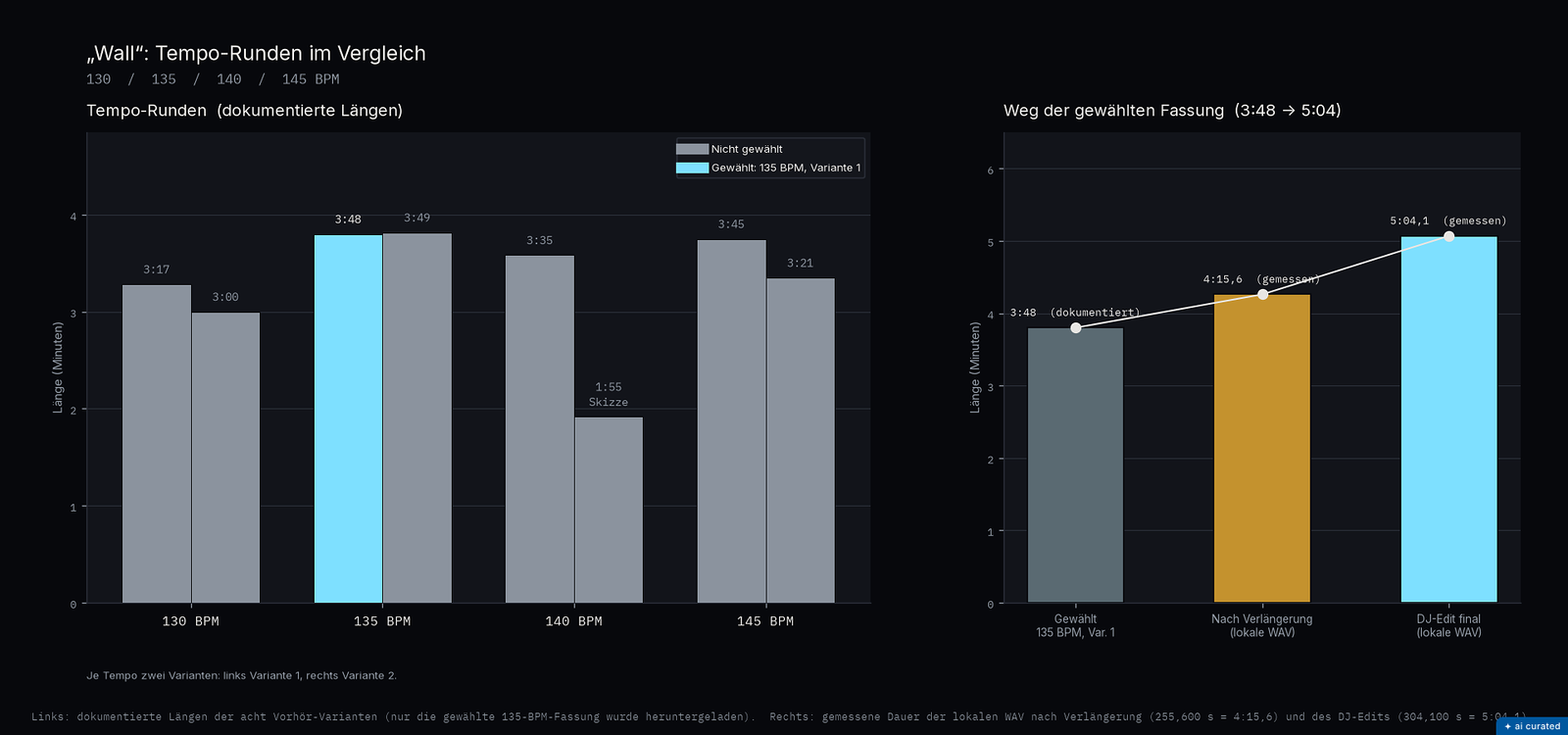
The first round at 130 BPM already pointed the right way, but still felt too tame to me. The next pass needed to sound more clearly like peak-time techno, and to sit at 135 BPM. I did not save a file from the 130 BPM round.
In the second round I sharpened the prompt: a heavy rumbling kick, a distorted bassline, fast hats, a slightly acid-tinged synth figure, large tension builds and hard drops. Of the two variants (3:48 and 3:49) I took the first. My comment was: “Krass, da geht in die richtige Richtung.” (“Wow, that’s heading in the right direction.”) I then wanted to hear the same approach at 140 and 145 BPM before committing. [1]
Round 3 used the same style prompt, with only the tempo figure changed. At 140 BPM there was a 3:35 version and a 1:55 sketch. At 145 BPM the lengths were 3:45 and 3:21. After that the choice was clear: 135 BPM, variant 1. 140 and 145 already leaned towards a harder, faster techno; 135 was the point where the track sat for me.
The exact style prompt of the winning version and the structure tags look like this:
instrumental peak time techno, 135 BPM, massive rumbling kick drum, driving distorted bassline, relentless energy, fast shuffling hi-hats and rides, aggressive acid-tinged synth stab hook, dark warehouse rave, big tension builds with risers and snare rolls, hard-hitting drops, festival main stage power, no vocals[Intro] [Instrumental] [Build] [Drop] [Instrumental] [Breakdown] [Synth Stab Hook] [Build] [Snare Roll] [Drop] [Outro] [End]The prompt deliberately left out artist, label and song names, and also any “in the style of …” wording, any speech, any lyrics and any “feat.” It said “no vocals” instead, because the historical voice was meant to come later from the secured archival source.
I listened first. Via the preview links I could compare eight variants and one extension. The download is the scarce monthly item. The documented steps on “Wall” cost around 55 credits and exactly one download. Afterwards, 2,335 credits and six downloads remained on the plan. Suno’s Pro tier provides 20 downloads per month; according to the help pages, unused downloads do not roll over. The account status at the time showed a renewal around 29 or 30 November 2026. The DJ edit, the mastering and the vocals did not use any additional credits or downloads. [1] [6]
From the draft to the DJ edit
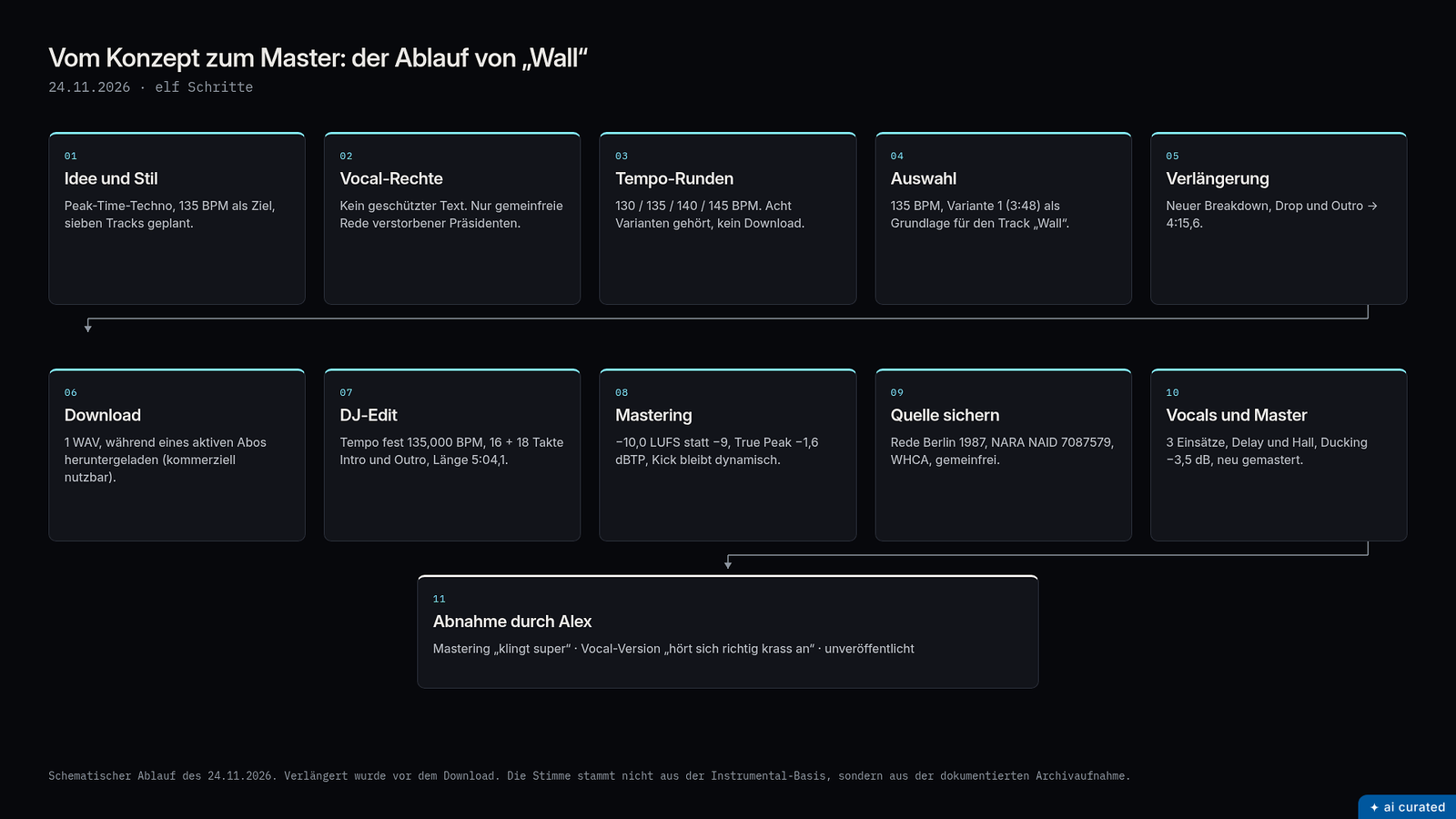
After the choice, the 135 BPM version was meant to grow to about five minutes. From 3:25 I extended it a first time, with a new breakdown, a synth stab, a build, a snare roll, a drop and a long outro. That took it to 4:15.6 (4:16 in the preview display). The structure tags for that extension were:
[Breakdown] [Synth Stab Hook] [Build] [Snare Roll] [Drop] [Instrumental] [Long Outro] [End]A second pass from 4:00 was meant to supply roughly the 45 seconds still missing, but stopped after a few seconds. The end and fade tags sat too early in the prompt and ended the run. I discarded that version. The lesson: if an extension still needs to add time, end and fade markers do not belong at the start of the prompt.
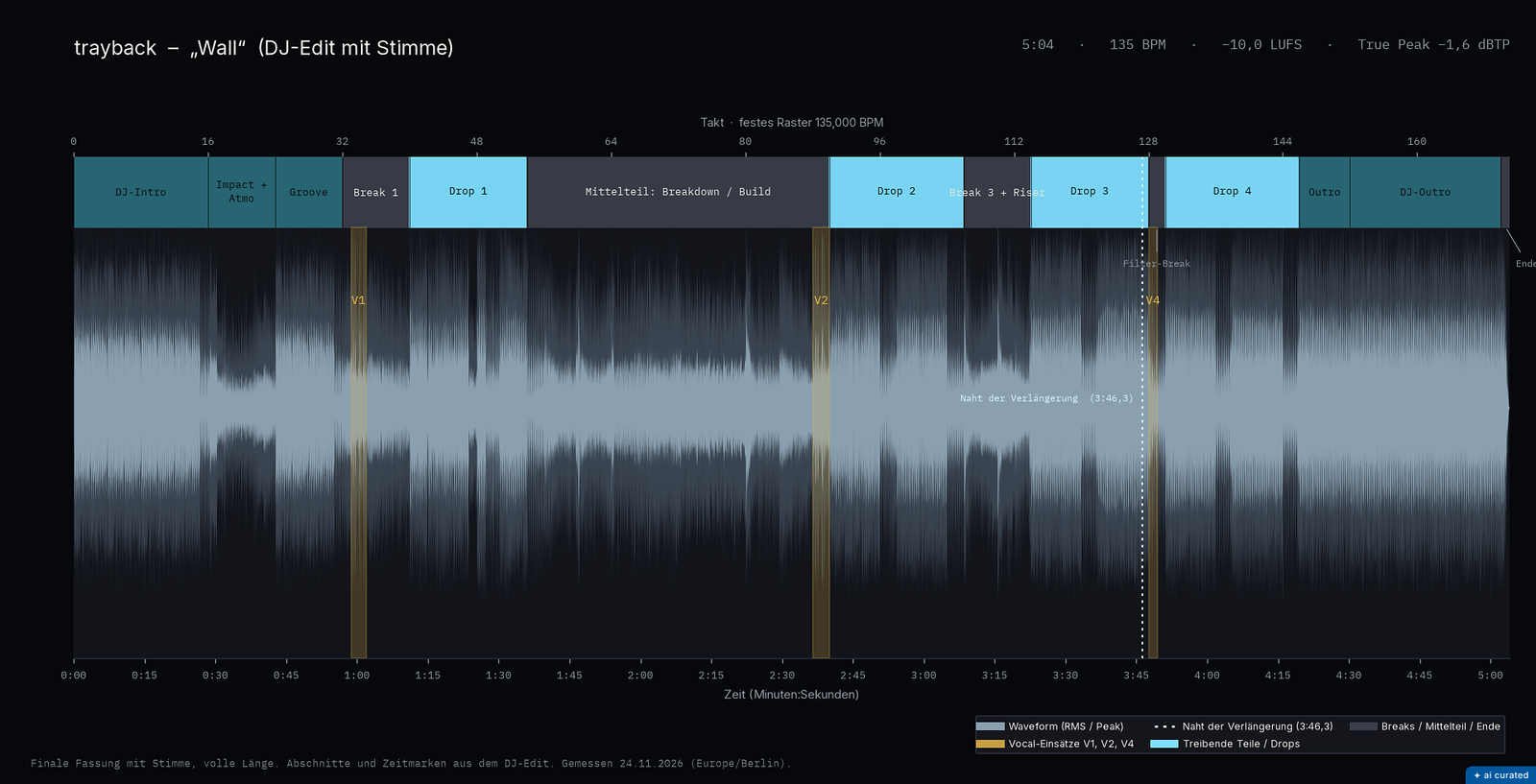
Instead of a risky third attempt, I saved the 4:16 version as a WAV, one of the seven monthly downloads then remaining, and built a DJ edit from it. In the downloaded file the tempo wandered from about 134.6 to 136.1 BPM, a plus of 1.1 percent. I brought it to exactly 135.000 BPM without changing the pitch. I added a 16-bar intro and an 18-bar outro, kick and bass only, so the track can be mixed. A final bar with a short cosine fade replaced the abrupt original ending. [1]
The seam of the extension sits at 3:46.3. There is no click and no jump in phase or tempo, but there is a change in sound: the extended section is a little quieter and darker. A filter break and a vocal echo sit immediately afterwards and help cover the transition.
Why the master sits at −10 LUFS and not at −9
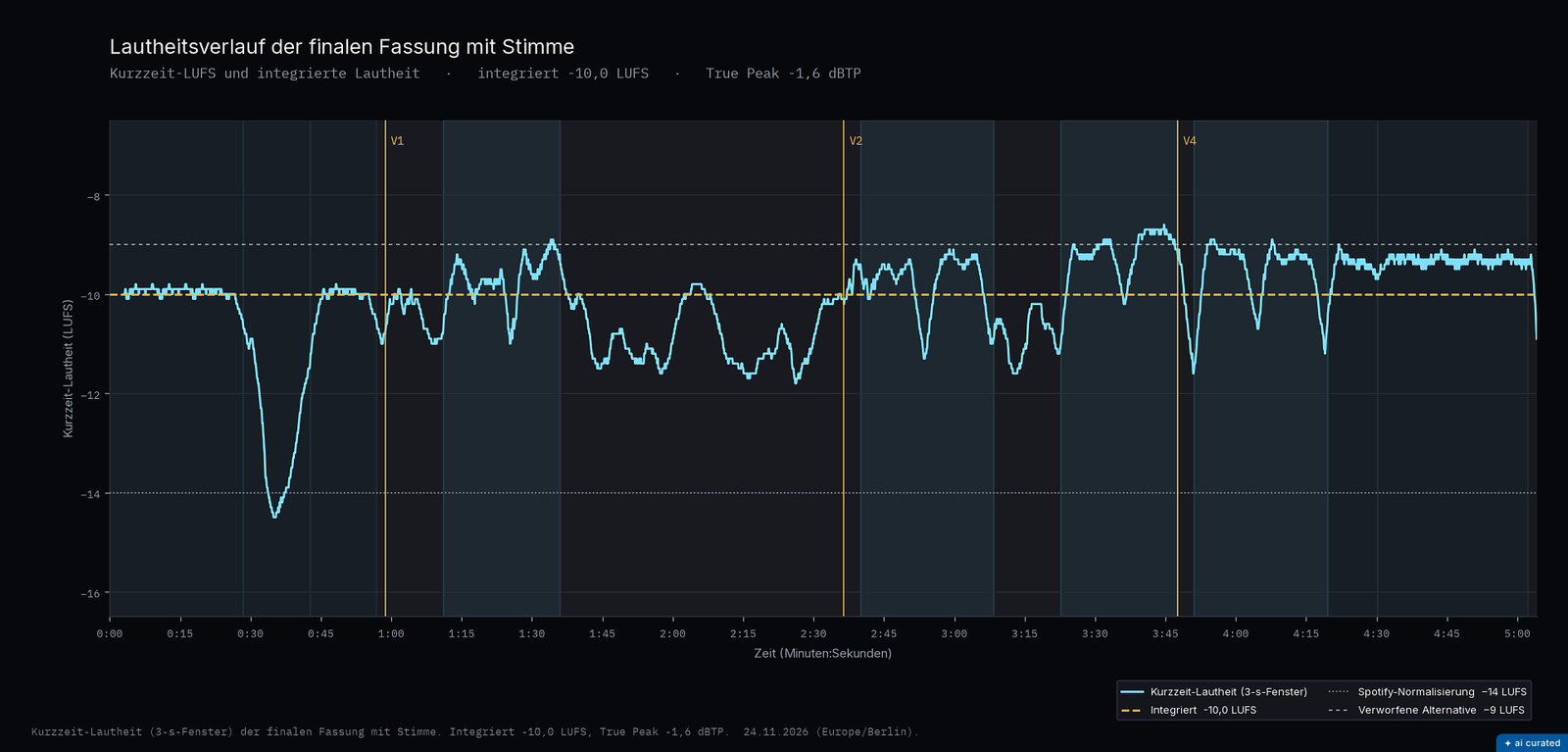
In mastering I weighed −9 against −10 LUFS. I settled on −10.0 LUFS integrated, because −9 would have made the kick noticeably flatter. A −9 target would have limited the signal by 0.84 dB on average and by up to 6.5 dB on peaks. At −10, limiting stays below one decibel at most points. The short-term loudness of the finished version with vocals reaches at most −8.6 LUFS, which sits above the discarded −9 line. That is exactly where a louder integrated target would have held the kick back more heavily. Streaming services such as Spotify typically level to −14 LUFS. For clubs and streaming, −10 is therefore a sensible middle ground. [1]
The same chain is used for the instrumental and the vocal version. The limiter runs at 4× oversampling, 1.5 ms lookahead, 60 ms release and a ceiling of −1.6 dBFS. Make-up gain is +5.4 dB; the source sat at −15.1 LUFS. The loudness range (LRA) is 2.3 LU. My comment on the instrumental master was: “Mastering klingt super.” (“The mastering sounds great.”)
The main moment before drop 2
The voice appears in three places. At 0:58, in the first breakdown, there is a teaser: “Mr. Gorbachev, open this gate!” The peak sits at 2:36, immediately before drop 2: “Mr. Gorbachev, tear down this wall!” The word “wall” reaches its loudest point about 0.15 seconds before drop 2 begins at 2:40.01, and still rings briefly into the drop. At 3:47, in the filter break, an echo of the same line follows, a little quieter and with more delay; it also helps cover the extension seam.
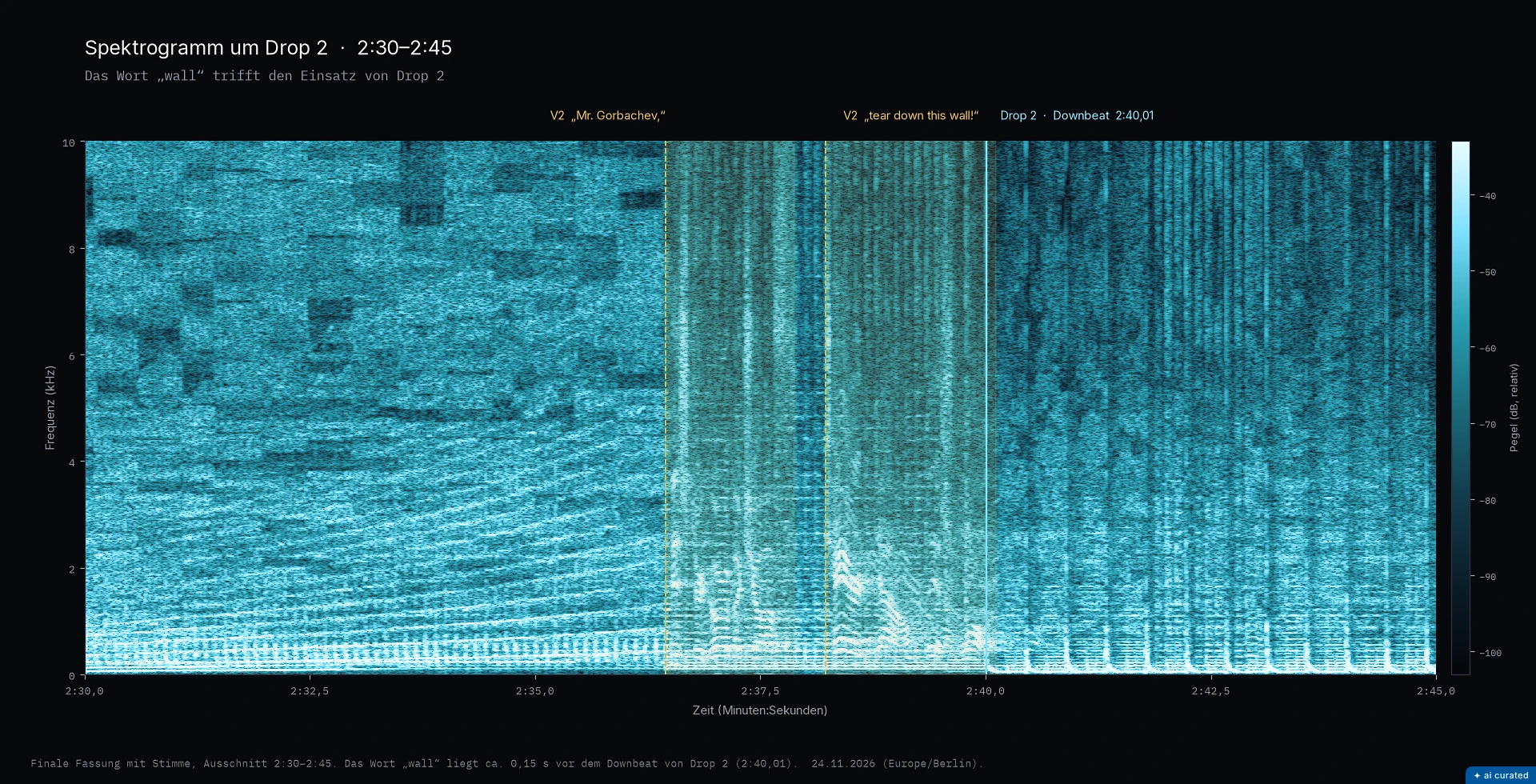
One technical hurdle in the archive file: the left and right tracks of the NARA MP3 are effectively out of phase (correlation −0.99). Added together as mono, the voice would almost have disappeared. I therefore used the difference of the channels, (L − R) / 2.
Before the mix, the clips were spectrally denoised, high-pass filtered at 160 Hz, low-pass filtered at 7.5 kHz and given a light telephone character. The mix adds a vocal limiter, a stereo-offset delay in the 135 BPM grid (dotted eighth 333.3 ms on the left, dotted quarter 666.7 ms on the right) and a plate-like reverb. The backing also falls by at most 3.5 dB under the voice. In the 1 to 4 kHz band, the voice sits 3.4 to 9.8 dB above the instrumental. The tightest spot is “open this gate!”, the clearest is “tear down this wall!”.
Between the parts of “tear down this wall!” the speaking pause was shortened slightly so that “tear” lands on the bar. The wording itself was not changed. A third entry around 3:19 was considered earlier and not used. My comment on the vocal version was: “hört sich richtig krass an!” (“It sounds really intense!”)
What I take from this
From this one day of production, these points stay with me:
- The prompt describes the sound, not the role models. Tempo, kick, bass, hook, the arc of tension and “no vocals” are enough.
- Listen first, and only then download. The monthly download allowance is scarce and should be used only once the choice is settled.
- Running the same style frame at several tempos proved worthwhile. 130 felt too tame, 140 and 145 were checked against it, and 135 was the point where the track sat.
- An in-tool extension only helps up to a point. A first attempt worked well; a second with early end markers did not. Length, a fixed grid and mixable intros are more reliably done in the edit after the download.
- The generated tempo can wander. Here it ran between 134.6 and 136.1 BPM. Before a club set I measure the grid and, if needed, stretch it in time without changing pitch.
- Loudness follows the kick, not the other way around. −9 LUFS would have been louder on paper, but would have made the kick flatter.
- Historical voices enter a track only from a documented source, and only once the instrumental is in place. Source, locations and the legal basis are settled before the first clip touches the track.
- Archival stereo with out-of-phase channels needs to be checked. Without (L − R) / 2 the voice would have vanished in a mono sum.
- The voice belongs on the rhythmic grid, not merely somewhere in the break. The word “wall” sits on the drop on purpose.
- I plan downloads and credits across the whole album. For track 1 it stayed at a single download.
What comes next for the short album
The plan remains seven tracks, four with vocals and three instrumental. A release, later including Spotify, will follow. I will handle distribution myself. Before the upload I still need to check the AI rules of the chosen distributor, including any labelling requirements. The cover has not been chosen yet, and the track stays unreleased until I approve publication.
For a similar look behind an AI production, in that case a poster and a short video, see GTA 6 launches on 19 November 2026: the facts and how I made my poster.
Frequently asked questions
May the Reagan speech be used in a track?
The recording used here is a government recording by the White House Communications Agency from 12 June 1987, archived under NARA NAID 7087579. In the United States it is a work of the US government and is not subject to copyright under 17 U.S.C. § 105. It is not a broadcaster’s tape. The voice is not presented as “feat. Ronald Reagan” and not as an endorsement. This overview is not legal advice. [2] [3]
Why was the “I Have a Dream” speech not used?
That speech is protected by copyright, and the rights holders actively enforce it. Without a written licence it would be a risk of a takedown or a formal complaint, especially if the track were released on Spotify. That is why a government recording with a documented public-domain status was chosen instead.
Why is the track mastered at −10 LUFS, not −9?
−9 LUFS would have made the kick noticeably flatter. It would have taken 0.84 dB of limiting on average and up to 6.5 dB on peaks. At −10.0 LUFS, limiting stays below one decibel at most points. In the drops, short-term loudness reaches −8.6 LUFS, which sits above the discarded −9 line. [1]
Is “Wall” already available, or on Spotify?
No. The track and the planned short album are not officially released yet. You can listen to the DJ edit with vocals in this post. There is no separate download link. I plan a later release, including on Spotify, and will handle distribution myself. Before that I will check the AI rules of the chosen distributor.
Sources
- Own production and measurements on 24 November 2026 (Europe/Berlin): length, tempo, loudness, vocal timings, the extension seam, and the credit and download count. The DJ edit with vocals is embedded as audio in this post.
- National Archives Catalog, NAID 7087579: President Ronald Reagan’s Address at the Brandenburg Gate, Berlin Wall, 12 June 1987, White House Communications Agency, held by the Ronald Reagan Presidential Library, use restriction: Unrestricted. Retrieved on 24 November 2026 at 17:49 (Europe/Berlin), directly from the NARA server.
- 17 U.S.C. § 105, Subject matter of copyright: United States Government works. Retrieved on 24 November 2026.
- Suno Terms of Service, last revised 10 August 2026, effective 3 September 2026, sections on Pro and Premier accounts and “Permitted Commercial Use”: commercial use of Output requires a permitted download under the applicable plan. Retrieved on 24 November 2026.
- Suno Help: What rights do I have with a paid subscription?, page listed as edited on 3 September 2026, retrieved on 24 November 2026. Songs downloaded while on a paid subscription are described as carrying commercial use rights in addition to personal use.
- Suno Help: How do downloads work? and Upcoming Changes FAQ: Downloads, Models, and Terms of Service, pages listed as edited on 13 November 2026, retrieved on 24 November 2026. The Pro plan includes 20 downloads per month; unused downloads are described as not rolling over.
✨ Curated and generated with AI, finalized by a human ❤️